Bathroom Window Privacy Film: Pro Installation Guide
For bathrooms, professional high-performance privacy film with expert installation is the best long-term solution. Curtains trap moisture and grow mold. Basic DIY films peel at the edges within a year in a steam-heavy shower environment. Professional-grade frosted or ceramic films, installed by a trained technician using moisture-resistant adhesives and precision cutting, hold up for years and deliver real comfort gains. Tintadvantage (Omaha Window Tinting) reports clients see cooling expense reductions of 10–20% and heat-gain cuts up to 80% with certain high-performance films.
- Hire a pro if your bathroom has a steam shower, complex glazing, or you want a warranty-backed result that lasts.
- Why it matters: Professional installation means correct adhesive selection, multi-stage cleaning, and edge sealing that DIY guides routinely skip.
- Next step: Contact Tintadvantage for a free on-site measure and estimate.
Table of Contents
- Why professional privacy film beats curtains, blinds, and DIY options
- How does professional bathroom window film installation work?
- Which privacy film types work best in bathrooms and why
- What does professional bathroom film installation cost?
- How do you choose the right professional installer?
- How do you clean and maintain bathroom privacy film?
- Common myths about bathroom privacy film
- Key Takeaways
- Why the “just buy it at the hardware store” instinct costs more in the long run
- Tintadvantage can handle your bathroom windows from measure to warranty
Why professional privacy film beats curtains, blinds, and DIY options
Curtains and blinds are the obvious first instinct, but bathrooms punish them quickly. Fabric absorbs steam, stays damp between showers, and becomes a mold surface within months. Even moisture-rated faux-wood blinds warp at the slats over time. High-performance privacy films are moisture-resistant by design, maintain consistent coverage in humid environments, and never need laundering or replacement slats.
Privacy consistency is the other gap. Mirrored or reflective films give daytime privacy but flip at night: once interior lighting is brighter than outside, anyone outside can see in clearly. Professional-grade frosted and etched films obscure the view in both directions, around the clock, regardless of lighting conditions.
Energy and UV protection add measurable value beyond privacy. Films rated for solar control block UV rays that fade towels, cabinetry, and flooring, and they reduce heat gain through glass-heavy bathrooms. That combination of privacy, durability, and thermal performance is simply not available from a curtain rod.
DIY film can be acceptable for a simple interior glass partition or a low-traffic powder room window. For steam showers, ground-floor exterior windows, or commercial bathrooms with heavy daily use, professional installation is the right call.
How does professional bathroom window film installation work?
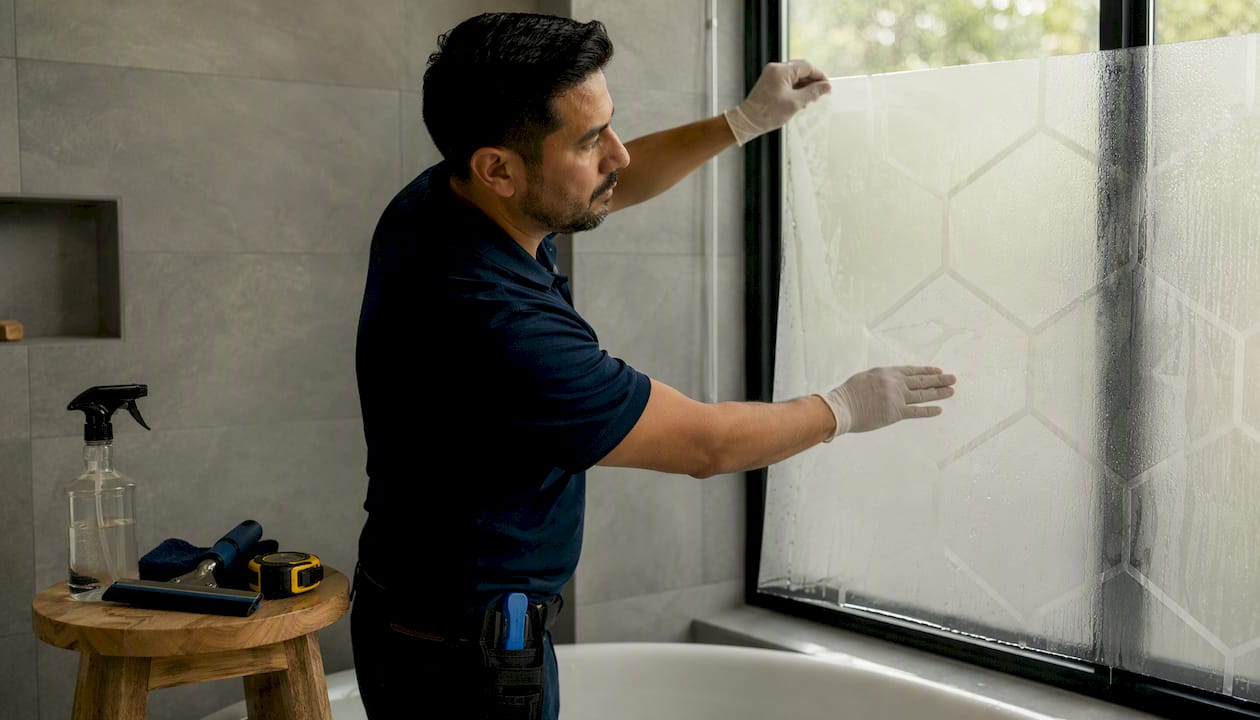
The full sequence runs: precision measurement → multi-stage glass cleaning → film selection → application with slip solution → systematic squeegeeing → edge trimming → cure period. Each step has a reason, and skipping any one of them is where DIY jobs fail.
- Precision measurement. The installer measures the exact glass dimensions, not the frame. Professionals cut film to fit without the extra 15% material buffer DIYers buy to compensate for cutting errors.
- Multi-stage cleaning. Glass must be free of oils, mineral deposits, and construction residue. A single missed contaminant causes a bubble that never fully flattens. Pros use a razor scraper followed by a cleaning solution, then a final wipe before the film touches the glass.
- Film selection for the environment. Bathroom films need moisture-resistant adhesive chemistry. The installer matches the film’s adhesive type to the humidity exposure level of the specific window location.
- Application with slip solution. The adhesive side is sprayed with a slip solution that allows repositioning. This is the window where alignment errors get corrected before the film sets.
- Systematic squeegeeing. Starting at the centerline and working outward, the installer removes trapped water and air. Poor squeegeeing is the leading cause of edge lifting and bubbles in DIY installs.
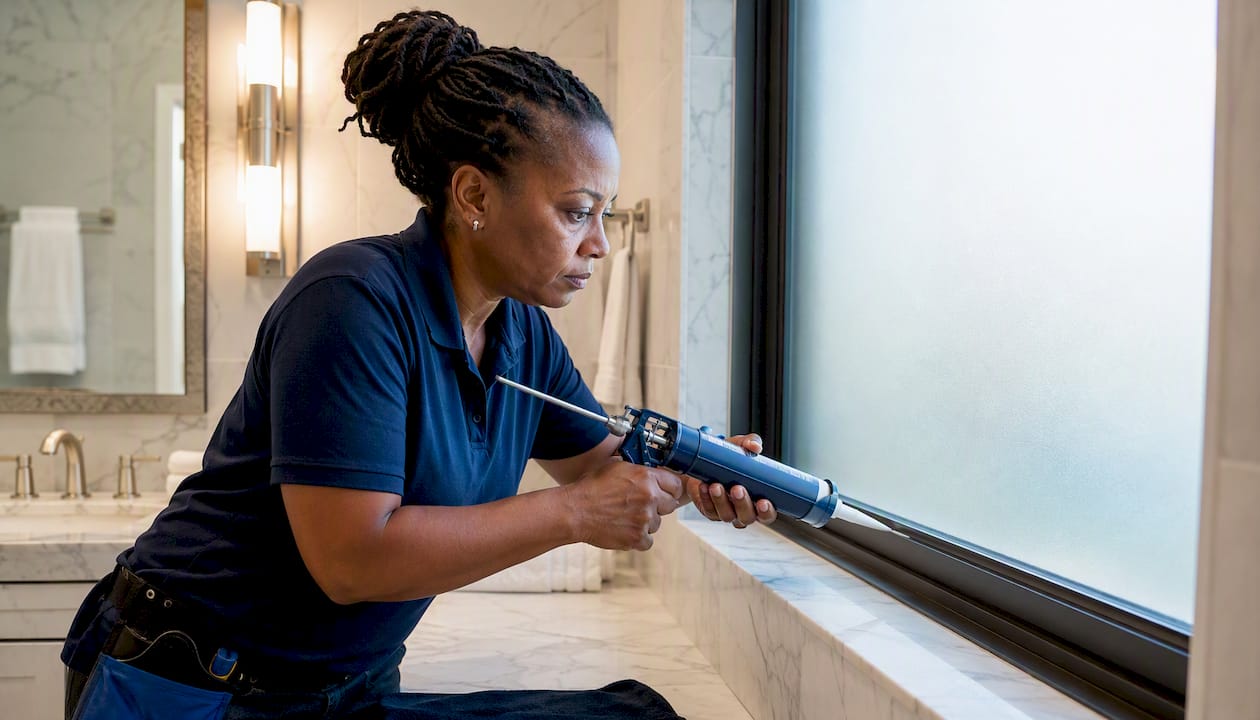
- Edge trimming. Excess film is trimmed flush to the glass border using the frame as a guide. Clean edges prevent moisture from wicking under the film at the perimeter.
- Cure time. Most films need several days to fully cure. During this window, small water pockets are normal and will disappear as the adhesive sets. The installer confirms the cure expectation before leaving.
Pro Tip: Ask the installer specifically about edge sealing on shower-adjacent windows. In high-steam zones, a silicone bead along the film edge adds a moisture barrier that standard trimming alone does not provide.
Pros also schedule installation to avoid direct sunlight on the glass. Applying film to hot glass causes the slip solution to dry too fast, leaving streaks and reducing adhesion. A professional controls that variable; a DIYer often cannot.
Which privacy film types work best in bathrooms and why
The right film depends on where the window sits, how much steam it sees, and how much natural light you want to keep.
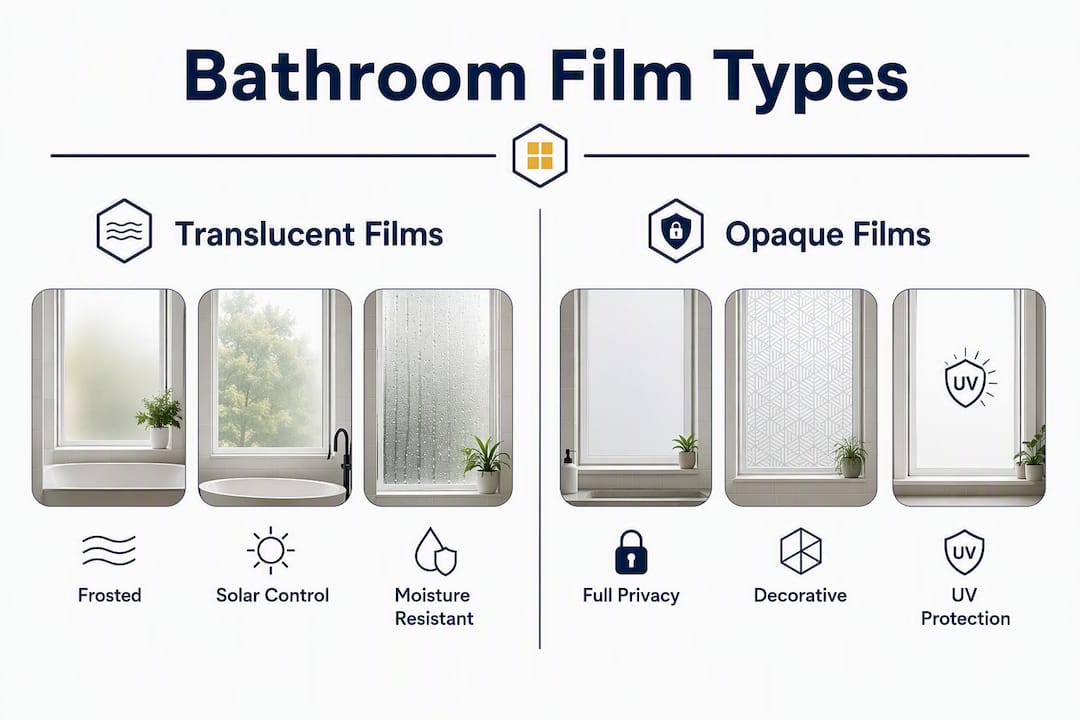
- Frosted/etched film is the default for most bathroom windows. It allows roughly 70% light transmission while providing close-range opacity and resistance to condensation. Works for exterior-facing windows and internal transoms alike.
- Whiteout/full opaque film is the choice when maximum privacy matters more than light. Ground-floor windows facing a sidewalk or neighbor’s sightline are the typical use case.
- Patterned/reeded decorative film diffuses light and adds a design element. Frosted films maintain privacy without a blackout effect and suit shower enclosures where some visual texture is preferred.
- Ceramic privacy film combines solar control with obscuration. It blocks UV and infrared heat while maintaining privacy, making it the right pick for sun-facing bathroom windows that overheat in summer.
Material considerations matter as much as appearance. VLT (visible light transmission) and adhesive chemistry both affect long-term performance in humid rooms. A film that looks identical to a cheaper option at install may yellow or peel within two years if the adhesive was not rated for steam exposure. For shower enclosures and steam rooms, always confirm the film is explicitly rated for high-humidity environments before installation.
When choosing between translucent frosted and full opaque, consider the window’s orientation. A north-facing bathroom window loses little natural light with a frosted film. A south-facing one in a small bathroom may feel noticeably darker with a whiteout film. A good installer will walk you through that trade-off on site.
What does professional bathroom film installation cost?
Pricing varies by film type, window complexity, and project size. A single standard bathroom window typically costs a moderate amount installed, depending on the film selected and local labor rates. Larger projects covering multiple windows, shower enclosures, or specialty glass cost more. Ceramic and high-performance solar films carry a higher material cost than basic frosted options.
| Cost driver | What affects price |
|---|---|
| Film type | Ceramic and solar-control films cost more than standard frosted |
| Window complexity | Curved glass, shower enclosures, and divided-light windows take longer |
| Project size | Per-window rates often drop on multi-window jobs |
| Warranty length | Manufacturer-backed warranties on premium films add value |
Timeline is straightforward for most bathrooms: a site measure takes 20–30 minutes, scheduling usually runs within a week, and a single bathroom window installs in under an hour. A full bathroom with multiple windows and a shower enclosure typically takes a half-day. The cure period runs 3–7 days, after which the installer should do a brief inspection.
Verify two warranties before signing: the manufacturer’s warranty on the film itself (covering delamination, yellowing, and adhesive failure) and the installer’s workmanship warranty covering the installation quality. Both should be in writing.
How do you choose the right professional installer?
Start with licensed and insured installers who have documented experience with bathroom and moisture-prone glazing specifically. General window tinters who primarily do automotive work may not stock moisture-rated films or know the edge-sealing steps that bathroom installs require.
- Ask for before-and-after photos from bathroom projects, not just commercial storefronts.
- Request the specific film brand and product line they plan to use, and verify it is rated for humid environments.
- Ask how they handle edge sealing on shower-adjacent glass.
- Confirm both the manufacturer warranty and their own workmanship warranty in writing before the job starts.
- Check for customer testimonials that mention bathrooms or steam showers specifically.
Red flags worth walking away from: a vague or verbal-only warranty, no portfolio of bathroom work, pressure to use the cheapest available film, or an inability to explain why adhesive chemistry matters in a humid room. A good installer welcomes those questions. For moisture-resistant materials and finishes in bathrooms more broadly, bathroom door material choices follow similar logic and are worth reviewing if you are doing a full bathroom renovation.
How do you clean and maintain bathroom privacy film?
Routine care is simple: wipe with a soft microfiber cloth and a mild soap solution, rinse lightly, and dry. That handles soap scum and water spots without damaging the film surface.
Avoid ammonia-based glass cleaners, abrasive pads, and razor blades on the film surface. Ammonia degrades certain adhesives over time, and abrasives scratch the film coating. The Gila installation guidelines specifically flag ammonia as a cleaner to avoid on film surfaces.
Pro Tip: Wait the full cure period (typically 3–7 days post-installation) before cleaning the film for the first time. Cleaning too early can disturb the adhesive bond before it has fully set.
Call the installer if you notice edge lifting, persistent bubbling after the cure period, or yellowing. Those symptoms often indicate an adhesive failure that falls under warranty coverage rather than a cleaning problem.
Common myths about bathroom privacy film
- Myth: All window films are the same. Professional-grade films use adhesive formulations and UV-stable coatings that consumer-grade rolls do not. The difference shows up in two to three years, not at install.
- Myth: Mirrored film gives you privacy at night. Reflective films work by reflecting the brighter side. At night, with interior lights on, the mirror effect reverses and the window becomes transparent from outside.
- Myth: DIY installation matches professional results. DIY guides themselves flag poor cleaning and inadequate squeegeeing as the top failure points. Pros eliminate those variables through specialized tools, controlled scheduling, and adhesive expertise.
- Egress and safety glazing note: Some bathroom windows are designated egress openings under local building codes. Film applied to egress windows must not obstruct operation. Check local code before covering any window that may serve as an emergency exit, and confirm with your installer that the film choice complies with any applicable safety glazing requirements.
Key Takeaways
Professional-grade frosted or ceramic bathroom window privacy film, installed with moisture-resistant adhesives and proper edge sealing, outperforms curtains, blinds, and DIY film on every measure that matters in a humid environment.
| Point | Details |
|---|---|
| Go professional for bathrooms | Moisture-resistant adhesives and edge sealing prevent the peeling and mold that curtains and DIY films develop. |
| Frosted film is the default choice | Frosted film allows roughly 70% light transmission while providing consistent, around-the-clock privacy. |
| Cooling and heat gains are measurable | Tintadvantage clients report 10–20% cooling expense reductions and heat-gain cuts up to 80% with high-performance films. |
| Verify two warranties | Get both the manufacturer’s film warranty and the installer’s workmanship warranty in writing before the job starts. |
| Tintadvantage is the recommended next step | Contact Tintadvantage for a free on-site measure, custom film selection, and professional installation with a workmanship warranty. |
Why the “just buy it at the hardware store” instinct costs more in the long run
Most homeowners who end up calling a professional installer have already tried a DIY roll. The pattern is consistent: the film looks fine for six months, then one corner starts lifting, a bubble forms near the shower, and by year two the whole pane needs to be stripped and redone. The stripping alone takes longer than the original install would have.
The real cost of bathroom privacy film is not the material. It is the adhesive chemistry and the preparation. A film that is not rated for steam exposure will fail in a steam shower regardless of how carefully it was applied. That is not a DIY skill gap. It is a material specification issue that only shows up when you know what to ask for.
Clients who invest in professional installation once, with the right film for their specific window location, typically do not revisit the decision for a decade. That is the actual value proposition: not just a prettier bathroom window, but one that stays that way.
Tintadvantage can handle your bathroom windows from measure to warranty
Tintadvantage (Omaha Window Tinting) installs high-performance privacy film for residential and commercial bathrooms across the area, with a process that covers everything from the initial site measure to final inspection. Every job includes custom film selection matched to your window’s humidity exposure, professional installation with moisture-resistant adhesives, and a workmanship warranty backed by manufacturer coverage on the film itself.

If you want a bathroom that stays private, comfortable, and low-maintenance without replacing glass or hanging curtains that mold, this is the direct path. Tintadvantage also installs solar control and safety films for the rest of your home or commercial property, so a single appointment can cover more than just the bathroom. Request your free on-site measure and estimate at tintadvantage.com and get a clear price before any work begins.