Conference Room Privacy Film: Choose Right, Install Smart
For most conference rooms, start with frosted or decorative window film. It delivers reliable visual privacy, keeps natural light flowing, and installs without electrical work or major disruption. If your space needs instant, switchable opacity or doubles as a projection surface, PDLC smart film is worth the added investment.
- Best for most rooms: Frosted or gradient film at eye level, full-width on glass partitions
- Best for executive boardrooms or AV-heavy spaces: Switchable PDLC film for on-demand opacity
- Immediate next step: Request sample swatches, schedule a site survey with Tintadvantage, and confirm your glass dimensions before ordering
Table of Contents
- What types of conference room privacy film are available?
- Why install privacy film beyond just confidentiality?
- How do you choose the right film for your space?
- What does conference room privacy film cost, and how long does it take?
- What does a professional installation actually look like?
- Why do some films fail at night?
- How can privacy film double as a branding tool?
- A real project: what Tintadvantage delivers in practice
- What is the best film for your conference room?
- Key Takeaways
- The installer’s perspective
- Tintadvantage handles the whole project, from survey to warranty
- Useful sources and datasheets for spec verification
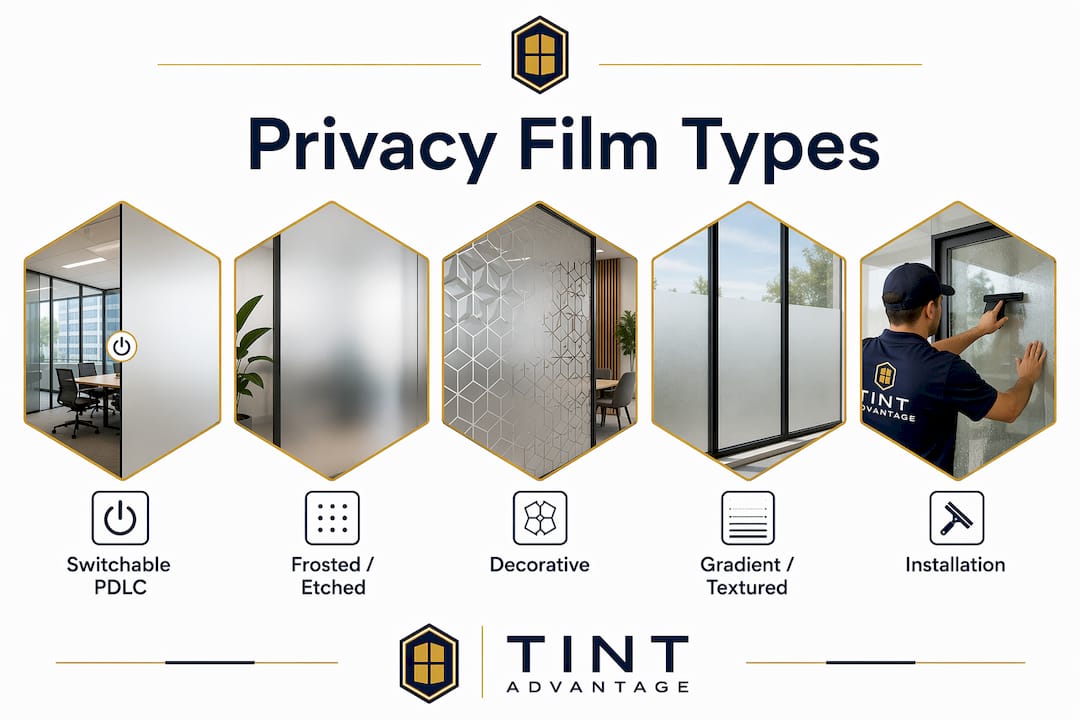
What types of conference room privacy film are available?
Not all privacy films work the same way, and the wrong choice creates problems you will not notice until after installation.
Frosted and etched vinyl
Cast frosted film mimics the look of acid-etched glass. It scatters light rather than blocking it, which means you get privacy without losing the open feel of a glass-walled room. Avery Dennison’s frosted film lists a visible light transmission (VLT) of around 46%, a useful benchmark when comparing products. This is the go-to choice for most standard conference rooms.
Decorative and printed films
Printed films let you embed logos, patterns, or brand colors directly into the glass surface. They work well on reception-facing glass walls where the partition doubles as a brand statement. VLT varies by print density, so always request a printed sample at your target opacity before approving a full run.
Gradient and textured films
Gradient films transition from opaque at eye level to clear above or below, preserving sightlines while blocking seated views from the corridor. Textured films add a tactile, architectural quality. Both suit open-plan offices where full opacity would feel oppressive.
Switchable PDLC smart film
PDLC switchable film goes from frosted to clear in under 10 milliseconds when powered. It also functions as a rear-projection surface in its opaque state, which makes it genuinely useful in AV-heavy boardrooms. The tradeoff: it requires electrical integration, a dedicated power supply, and careful wire concealment. Think of it as an electrical asset, not just a window treatment.
| Film Type | Privacy Level | VLT Range | Cost Tier | Electrical? | Best Fit |
|---|---|---|---|---|---|
| Frosted/etched vinyl | High (diffused) | 46% | Low–Mid | No | Standard conference rooms |
| Decorative/printed | Medium–High | Varies by print | Mid | No | Branded glass partitions |
| Gradient/textured | Partial (eye level) | over 70% | Mid | No | Open-plan, collaborative spaces |
| Switchable PDLC | Full on/off | 0% (opaque) / 70%+ (clear) | High | Yes | Boardrooms, AV projection rooms |
Why install privacy film beyond just confidentiality?
Privacy is the obvious reason, but facilities teams usually find three or four other benefits that justify the budget on their own.
Glare control is the one most people underestimate. Glass-walled conference rooms catch afternoon sun at exactly the wrong angle for presentations. A frosted or gradient film diffuses that light before it hits the screen, which means fewer complaints about washed-out slides and less time adjusting blinds mid-meeting.
UV protection matters for furnishings and occupant health. Quality window films block a significant portion of UV radiation, which reduces fading on carpet, upholstered chairs, and whiteboards near exterior glass. This extends the life of interior finishes in rooms that get heavy sun exposure.
Branding and design are where printed decorative films earn their keep. A frosted partition with a cut-vinyl logo costs a fraction of custom etched glass and can be updated when the brand refreshes. That flexibility matters for growing companies.
Spec callout: A frosted cast film with a VLT of ~46% passes roughly half of available daylight while providing full visual screening at seated height. Switchable PDLC in its clear state can exceed 70% VLT, dropping to near 0% when powered opaque.
Occupant comfort rounds out the case. Rooms that run cooler and glare-free tend to produce shorter, more focused meetings. That is harder to put a dollar figure on, but facilities managers who have made the switch report it consistently.
How do you choose the right film for your space?
Work through these questions before you talk to an installer. The answers will narrow your options fast.
- What privacy level do you need? Full visual block for a boardroom, partial eye-level screening for a team room, or switchable for a multipurpose space?
- What happens after dark? If the room is used at night with interior lights on, translucent films may not provide adequate privacy (more on this in the nighttime section below).
- What is your VLT target? Aim for a balance of visible light transmission to balance privacy and daylight in most office environments.
- Do you need branding or graphics? Printed films require longer lead times and a sample-approval step.
- What is your budget and timeline? Frosted vinyl is the fastest and most affordable; PDLC adds electrical scope and cost.
- Do you have safety or security requirements? Some films add shatter resistance, which matters for ground-floor or high-traffic glass.
- What warranty do you need? Commercial installations should carry a minimum five-year manufacturer warranty backed by a certified installer.
Questions to ask your installer:
- Can I see physical swatches and a mockup on my actual glass before committing?
- What adhesive system do you use, and how do you seal edges?
- What does the warranty cover, and who handles claims?
- For PDLC: what power supply and voltage does the film require, and how will wiring be routed and concealed?
- Can you provide photos or references from comparable commercial projects?
Red flags: No physical samples, specs quoted without VLT or UV-block figures, no written warranty, and any installer who cannot show you a completed commercial project.
Pro Tip: Ask for a sample applied directly to a spare piece of glass or a corner of your actual partition. Lighting conditions in your office will look different from a showroom sample held up to a window.
What does conference room privacy film cost, and how long does it take?
Costs vary significantly by film type, glass area, and project complexity.
- Frosted or gradient film: Generally the most accessible price point per square foot, with most standard conference room projects completing in a single day
- Decorative printed film: Custom printing adds cost and lead time; expect a sample-approval cycle of one to two weeks before installation
- Switchable PDLC film: The highest cost tier, driven by the film itself, the power supply, electrical routing, and any integration with building management systems; PDLC requires a dedicated power supply and careful wire concealment, which adds both labor hours and materials
Factors that move the price up:
- Custom printing with brand colors or photographic imagery
- Curved, segmented, or unusually large glass panels
- Electrical work and conduit routing for PDLC
- After-hours or weekend installation to avoid disrupting meetings
- Multi-floor or multi-room projects requiring phased scheduling
Typical project timeline: Site survey (one visit), sample approval (one to two weeks for printed films, faster for stock frosted), installation day(s), and a cure period of several days before cleaning. Most passive film projects wrap in under a week from approval to completion. PDLC projects with electrical scope typically run two to four weeks from survey to sign-off.
Budget note: PDLC self-adhesive retrofit sheets are available in widths from 1,000 mm to 1,800 mm with recommended sheet lengths under 3 meters. Larger glass panels require seamed installations, which affects both cost and aesthetics.
What does a professional installation actually look like?
A well-run install is mostly invisible to building occupants. Here is what the process looks like from the inside.

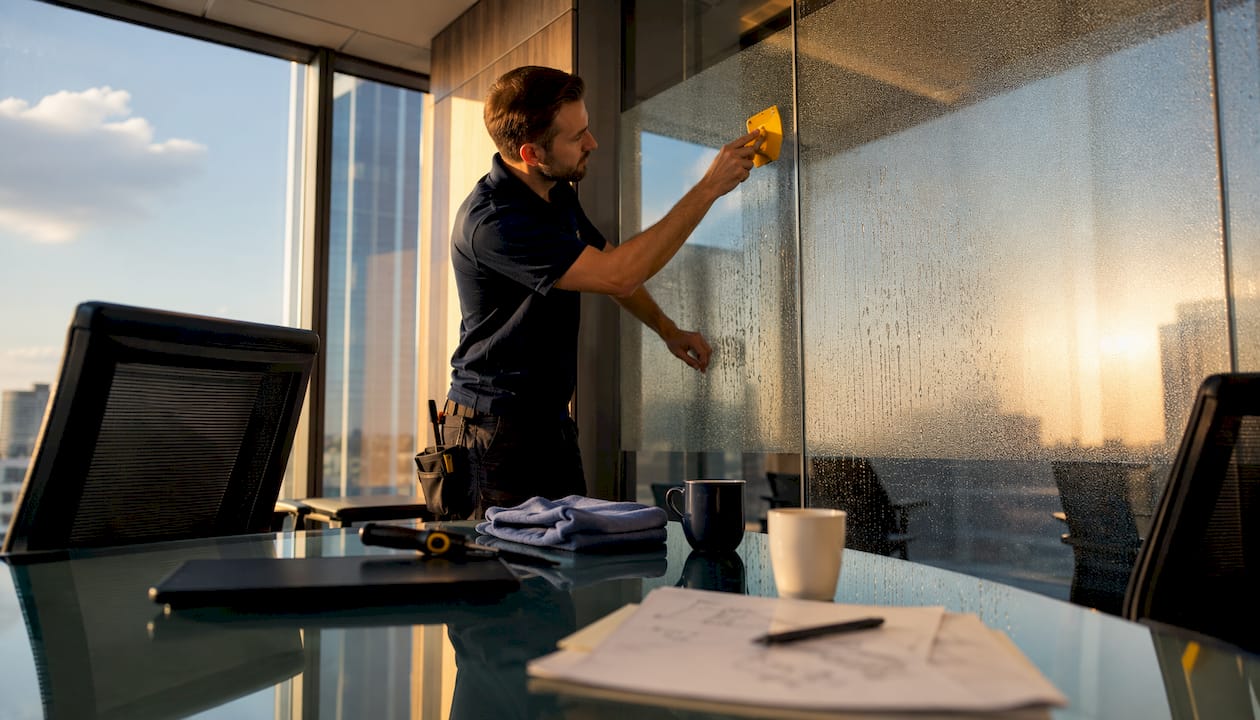
Before install day: The installer measures every panel, confirms the film specification against the approved sample, and schedules around room bookings. Glass surfaces must be clean and free of any coatings, stickers, or residue. Surface contamination is the leading cause of adhesion failure, so professional installers use controlled cleaning agents rather than general-purpose sprays.
On install day: The crew applies film using a wet or dry method depending on the adhesive system, works out air and moisture with a squeegee, and seals all edges. For PDLC, electrical leads are routed and terminated before the film is powered for the first time. The installer should do a final check against the approved sample before leaving.
After installation: Most films have a cure period of several days to a couple of weeks depending on adhesive type and ambient humidity. During cure, minor haziness or small water pockets are normal and will clear. Do not clean the film during this window.
Maintenance do’s and don’ts:
- Use a soft cloth and a mild, ammonia-free cleaner
- Avoid abrasive pads, razor blades, or solvent-based products
- Report any lifting edges promptly; early re-sealing prevents larger adhesion failures
- Keep warranty documentation and the installer’s contact information on file for claims
Pro Tip: Schedule installation for a Friday afternoon or over a weekend. Films need minimal disturbance during the first 24–48 hours of cure, and conference rooms are typically the hardest spaces to keep clear on a weekday.
Why do some films fail at night?
This is the question most buyers do not ask until after installation, and it catches a lot of people off guard.
Frosted and translucent films work by diffusing light. During the day, exterior light is brighter than interior light, so the film scatters incoming daylight and makes it hard to see through from outside. After dark, the equation flips: interior lights are now brighter than the dark exterior, and anyone standing outside can see silhouettes or movement through the film.
- One-way mirror films depend entirely on this light-ratio principle. They do not provide privacy when the brighter side is interior.
- Translucent frosted films reduce clarity but do not eliminate silhouettes when interior lighting is high.
- True nighttime privacy requires either reducing interior light levels, adding roller shades or blackout panels for after-hours use, or installing switchable PDLC film that goes fully opaque on demand.
The practical fix for most offices is a layered approach: frosted film handles daytime privacy, and a simple roller shade or motorized blind covers the after-dark gap. For rooms where nighttime confidentiality is non-negotiable, PDLC is the cleaner solution.
How can privacy film double as a branding tool?
Glass partitions are some of the most visible surfaces in an office. Treating them as blank walls is a missed opportunity.
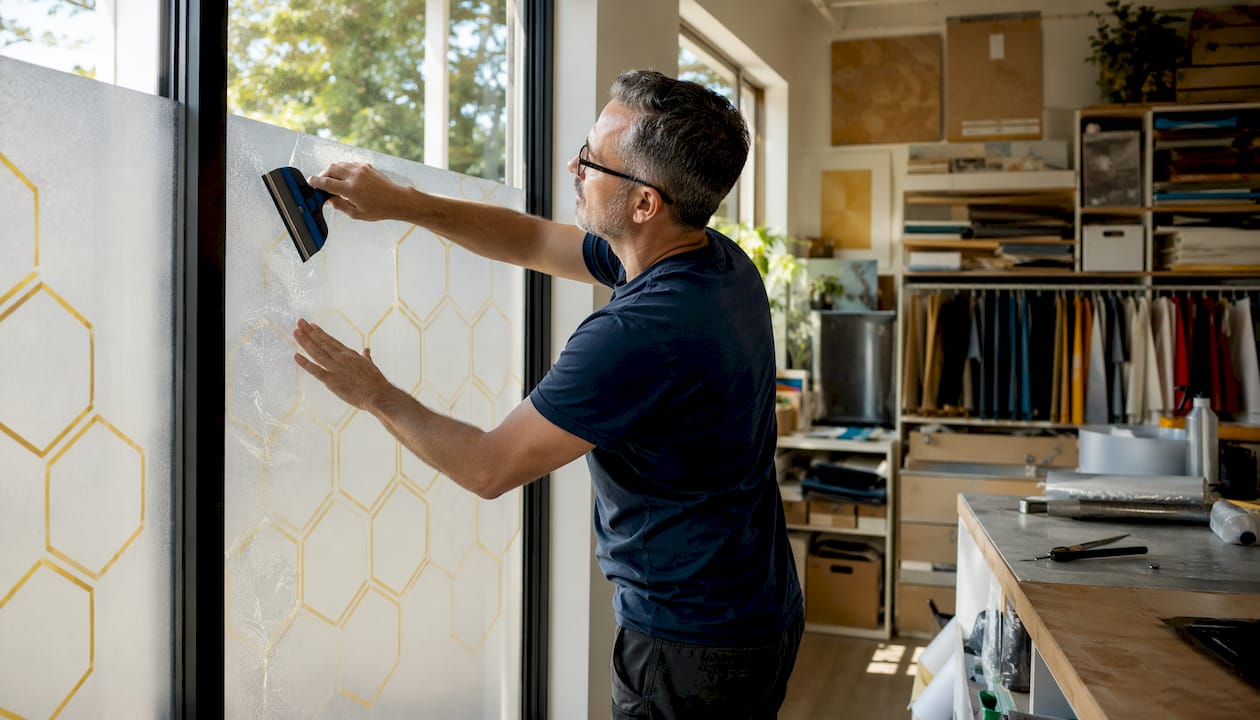
Printed decorative films can carry full-color logos, geometric patterns, photography, or abstract textures. Cut vinyl gives you crisp, single-color graphics at a lower cost. Gradient films create a designed look without any printing at all. The options range from subtle to bold, and the right choice depends on how the room reads from the corridor and from inside.
Design tips that actually matter:
- Test legibility at the distances people will actually view the glass, not just up close
- Request a physical proof at your target opacity before approving a full print run; colors shift when film is applied to glass
- Keep the upper portion of the glass clear or lightly treated to preserve sightlines and the sense of openness
- Confirm that custom printing does not drop VLT below your target; denser prints transmit less light
Custom printing adds one to two weeks of lead time in most cases. Plan for that in your project schedule, and get the proof approved before the installation date is locked in.
A real project: what Tintadvantage delivers in practice
A mid-size professional services firm approached Tintadvantage to address two problems in their main conference room: a glass partition facing a busy open-plan floor was creating constant distraction during client meetings, and afternoon sun was washing out their presentation screen.
The solution was a gradient frosted film applied from floor to 72 inches, transitioning to clear above. The film reduced visible glare on the AV screen without blocking the natural light that made the room feel open. Occupants reported an immediate improvement in meeting focus, and the facilities manager noted that the room’s afternoon temperature felt noticeably more comfortable.
Key outcomes from the project:
- Gradient film maintained daylight while providing full seated-height privacy
- Glare on the presentation screen was reduced without blackout treatments
- Installation completed over a single weekend with no disruption to the Monday schedule
- The film carried a manufacturer-backed warranty with Tintadvantage as the certified installer
What is the best film for your conference room?
Match the film to the room’s actual use, not just the privacy requirement.
- Standard team rooms and glass partitions: Frosted or gradient film is the right call for most situations. Order swatches, confirm VLT against your lighting conditions, and schedule a site survey with Tintadvantage to verify glass type and dimensions.
- Executive boardrooms and AV-heavy spaces: Switchable PDLC gives you full opacity on demand and doubles as a projection surface. Before committing, confirm the electrical scope with your facilities team and get a wiring plan from the installer.
- Branded reception-facing glass: Printed decorative film with a cut-vinyl logo or pattern. Request a printed proof at scale before approving.
Three-step action plan:
- Order physical swatches for the film types you are considering and test them on your actual glass in your actual lighting conditions.
- Schedule a site survey with Tintadvantage. Bring your glass dimensions, a photo of the space, and any brand guidelines if you are considering printed film.
- If PDLC is on the table, confirm the electrical scope early. PDLC smart film requires a dedicated power supply and professional wiring, which needs to be coordinated with your building’s electrical team before installation day.
For high-traffic conference rooms, professional installation is not optional. Surface prep, edge sealing, and adhesive technique directly determine how long the film lasts and whether the warranty stays valid.
Key Takeaways
Frosted or gradient film covers most conference room privacy needs without electrical work, while PDLC switchable film is the right call when you need instant, full opacity or a built-in projection surface.
| Point | Details |
|---|---|
| Start with frosted film | Frosted or gradient film handles most conference rooms: reliable privacy, moderate visible light transmission, no electrical work. |
| Night-time caveat | Translucent films flip at night; add roller shades or choose PDLC for after-dark confidentiality. |
| PDLC is an electrical asset | Switchable film needs a dedicated power supply and professional wiring; plan electrical scope early. |
| Always test before committing | Request physical swatches applied to your actual glass before approving any film or print run. |
| Tintadvantage for commercial installs | Tintadvantage handles frosted, printed, and PDLC installations with warranty-backed craftsmanship in the Omaha area. |
The installer’s perspective
The question I hear most often from facilities managers is some version of: “Can we just order the film online and have our maintenance crew put it up?” The honest answer is: for a small window in a back office, maybe. For a glass-walled conference room that clients see every day, no.
The failure points are almost always surface prep and edge sealing. Microscopic oils and dust particles trapped under the film during installation cause bubbles that do not clear after cure. Edge lifting in high-traffic rooms starts at the corners and works inward. Neither problem shows up immediately, which is why buyers sometimes think a DIY install worked fine, until six months later when the film is peeling and the warranty is void because no certified installer touched it.
For PDLC projects, the electrical routing is where I see the most shortcuts. Visible cables or improperly terminated leads are not just an aesthetic problem; they create maintenance headaches and can create safety issues if the power supply is not matched correctly to the film’s voltage requirements.
The prep work, the edge seal, the electrical coordination: that is what a professional installation actually buys you, not just the labor of sticking film to glass.
Tintadvantage handles the whole project, from survey to warranty
Skip the guesswork on specs, samples, and scheduling. Tintadvantage offers free site surveys for commercial privacy film projects in the Omaha area, covering glass measurement, film selection, and a written estimate before any commitment.
Services include commercial frosted and gradient film, custom printed decorative film, PDLC switchable film with full electrical coordination, and warranty-backed installation on every project. When you book a survey, bring your glass dimensions and any brand guidelines. The team will confirm glass type, recommend VLT targets for your lighting conditions, and walk you through sample options on-site.
Ready to move from research to installation? Request your site survey at Tintadvantage and get a written estimate within the week.
Useful sources and datasheets for spec verification
When evaluating film options, go directly to manufacturer datasheets rather than relying on installer claims alone. Here is what to look for and where to find it.
- Avery Dennison frosted film datasheet: Check VLT, haze percentage, adhesive type, and warranty period. The frosted glass product lists a VLT of approximately 46%.
- Smart Film switchable PDLC project page: Review response time specs (under 10 ms), available configurations, and corporate installation case studies.
- Noyark PDLC retrofit film specs: Check available widths (1,000–1,800 mm), maximum sheet length recommendations, and response time.
- 3M decorative window film design resources: Useful for printed film options, brand color integration, and design guidance.
- Solar Screen installation guide: Covers surface preparation standards, adhesive systems, and edge-sealing best practices.
On any datasheet, confirm: VLT, UV block percentage, response time (PDLC only), working voltage (PDLC only), mechanical lifespan rating, and warranty terms. If a product page does not list these figures, ask the manufacturer directly before specifying the film.
Tintadvantage’s project and contact page includes examples of completed commercial installations and a direct line for estimate requests.