Facility Managers: Daycare Window Film ROI and Room by Room Safety
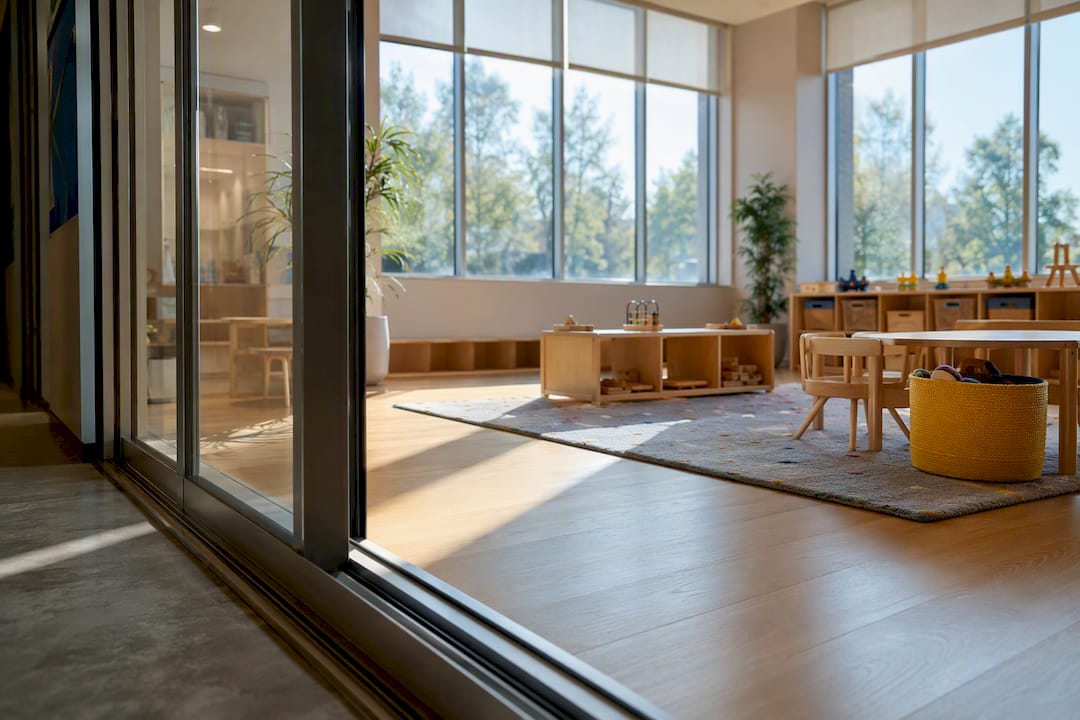
For most daycares, the right approach is layered: clear safety/security film on every child-accessible pane, targeted solar and UV control on sun-facing rooms, and selective frosted privacy film for nap rooms and restrooms. That combination contains glass shards if a window breaks, blocks harmful UV rays, cuts heat and glare, and still lets teachers see every corner of the room.
TL;DR:
- Safety films on accessible windows mainly delay entry and contain shards but do not make windows indestructible or fully impact-proof.
- Frosted and patterned privacy films can hinder supervision if not chosen carefully; partial frosting offers privacy without compromising sightlines.
- Proper installation by professionals is essential, especially for large exterior panes or safety-critical areas, as poor application can cause early failure or glass cracking.
- The lifespan of films ranges from 7 to 15 years depending on type and exposure, with proper installation and maintenance significantly increasing durability.
Table of Contents
- What Daycare Window Film Types Go Where
- What Safety Film Actually Does (and Doesn’t)
- Sun Control, UV Blocking, and the Numbers That Matter
- Balancing Privacy With the Need to Supervise
- Installing Window Film: DIY Checklist and When to Call a Pro
- What Window Film Costs and When It Pays Off
- How to Vet Window Film Installers Before You Sign
- Maintenance and Cleaning Tips for Daycare Window Films
- Health and Safety Compliance Specific to Daycare Environments
- How Window Film Affects Natural Light and Comfort
- How Long Different Daycare Window Films Actually Last
- Practitioner Notes: What We See on Daycare Projects
- Ready to Get Your Daycare Windows Assessed?
- Sources
What Daycare Window Film Types Go Where
Not every window in a building needs the same treatment, and trying to apply one film everywhere usually wastes budget. The smarter move is matching film type to the job each window actually does, which also keeps sightlines intact for the adults who need them most.
Safety and security film typically runs 4 to 14 mil thick and gets applied to glass within reach of children, low sidelights, and any exterior door glazing near play areas. It holds shattered glass together instead of letting it scatter into a room full of toddlers.
Solar control films target sun-facing classrooms and reduce the heat and glare that make afternoon nap time miserable in a west-facing room. UV-blocking films often ride along with solar films, cutting the invisible rays that fade art projects and hit exposed skin all day.
Privacy and decorative films solve a different problem entirely: keeping strangers from peering into infant rooms or restrooms while still letting light through.
A rough room-by-room map is as follows:
- Play areas and classrooms: safety film plus solar control on any sun-exposed wall
- Nap rooms: frosted privacy film, often combined with a light-dimming or UV layer
- Entry and reception: safety film for security, decorative film for branding or address markings
- Observation windows: clear safety film only, no frosting, so supervision never gets blocked
What Safety Film Actually Does (and Doesn’t)
Security window film holds broken glass fragments together to slow intrusion and reduce injury risk, but it doesn’t turn a window into something indestructible, according to a complete guide to glass protection and safety. A determined impact will still break through eventually. Film buys time and reduces shard hazards. It’s not a vault door.
Two standards come up constantly in procurement conversations:
- ANSI Z97.1 covers safety glazing performance for architectural glass
- CPSC 16 CFR 1201 sets federal safety glazing requirements relevant to buildings serving children
Ask any installer for documentation showing how their film performs against these benchmarks. A reputable installer will have it ready, not promise to “look into it.”
Statistic to remember: safety film contains shards and delays entry, but it complements code-required safety glazing rather than replacing it. Cracked frames, failing seals, or already-compromised glass can rule out certain films entirely, which is exactly why a walk-through beats a phone quote every time.
Sun Control, UV Blocking, and the Numbers That Matter
Solar control films can reject a high percentage of incoming solar heat and significantly reduce peak-season cooling energy use, according to 3M’s home window energy data. For a daycare running HVAC all day with a building full of kids generating their own heat load, that’s not a small number. Case-study modeling on commercial buildings shows similar peak cooling reductions once film goes on sun-exposed glass, per research published in Sustainability.
On the UV side, many quality films block most UV rays, according to the Skin Cancer Foundation. That matters twice over in a daycare: less UV exposure for kids sitting near windows all day, and less fading on murals, furniture, and flooring. Manufacturer lines like 3M’s Prestige series push UV rejection even higher while keeping visible light transmittance strong, which keeps rooms bright instead of dim.
Winter brings a small trade-off: some films slightly increase heating load since they block a bit of passive solar warmth too. When you’re comparing vendor quotes, ask for three specific numbers: heat rejection percentage, visible light transmittance (VLT), and UV block percentage. Anyone who can’t answer clearly hasn’t done this before.
Balancing Privacy With the Need to Supervise
Frosted, patterned, and one-way films all block outside eyes differently, and picking the wrong one can quietly wreck a teacher’s ability to watch a room. Full frosting looks tidy but can turn a nap room into a cave by midafternoon. One-way films work only under specific light conditions and can flip in behavior once the sun moves.
- Frost the lower two-thirds of a window and leave the top clear for daylight
- Use patterned or etched film in restrooms where full privacy matters more than sightlines
- Keep a clear observation strip at adult eye level on any door with a supervision requirement
- Check frosted film periodically. Fingerprints and smudges show up faster on privacy film than clear film
Our guide on nighttime window privacy covers how privacy film behaves after dark, which matters for daycares running early drop-off or late pickup in low light.
Installing Window Film: DIY Checklist and When to Call a Pro
Safety film on large exterior panes, anything tied to a warranty, and any project where documentation matters for licensing should go to a professional installer. Full stop. The margin for error is too tight on child-safety projects to treat it as a weekend job.
If you’re weighing DIY on lower-stakes interior windows, here’s the general installation flow:
- Clean the glass completely. Any dust or debris gets trapped under the film permanently.
- Mix a proper slip solution and apply it evenly to the glass.
- Position the film, then squeegee out air bubbles and excess solution from the center outward.
- Dry and seal the edges carefully to prevent lifting over time.
Skipping steps here causes most of the failures installers get called to fix, according to Windowfilm.
Glass compatibility is the other risk. Older or already-stressed glass can react badly to certain films, and thermal stress from the wrong film-glass pairing can crack panes that were fine before installation, per glass industry guidance on thermal stress. Our post on whether window film can crack glass walks through exactly when that risk shows up.
Pro Tip: Ask your installer to show you a sample panel and written documentation before work begins, not after. A legitimate crew will already have both ready.
What Window Film Costs and When It Pays Off
Cost depends on a handful of factors: glass square footage, film grade, how many windows need safety versus solar versus privacy treatment, and whether frames need prep work first.
- Safety film generally costs more per square foot than standard solar film due to thickness and edge-attachment work
- Larger commercial panes cost more to treat than standard residential-sized windows
- Bundling safety, solar, and privacy work into one project often reduces per-window labor costs
Window film is often more budget-friendly than full window replacement, and high-quality installations can see payback under three years through energy savings alone, according to the Department of Energy. Ask about local utility rebates or energy-efficiency incentives before finalizing a budget. Some jurisdictions offer them for commercial buildings, and they can shave real money off the upfront number.
How to Vet Window Film Installers Before You Sign
A short checklist keeps proposals honest and comparable side by side:
- Request an on-site assessment. Photos alone don’t capture glass condition or frame issues.
- Ask for compliance documentation tied to ANSI Z97.1 and CPSC 16 CFR 1201 where safety film applies.
- Get warranty terms in writing, including what voids coverage.
- Request a sample panel installed on-site before committing to the full job.
- Ask for references from other daycare or school projects specifically.
- Confirm whether a maintenance plan is included or billed separately.
When you compare bids, line up the same three specs across every proposal: heat rejection percentage, VLT, and UV block percentage. A cheaper quote missing those numbers usually isn’t actually cheaper once you know what film it’s using.
Maintenance and Cleaning Tips for Daycare Window Films
Window film holds up well over the years, but only if it gets cleaned the right way. The biggest mistake facility staff make is treating tinted glass like regular glass and grabbing whatever ammonia-based cleaner is under the sink. Ammonia degrades most film adhesives over time and can cause bubbling or discoloration.
Stick to a soft, non-abrasive cloth or squeegee with a mild soap-and-water solution. Avoid paper towels, which can micro-scratch the film surface, and skip anything with scouring particles. For daycare environments specifically, where little hands leave prints constantly, a light daily wipe with a microfiber cloth keeps glass looking clean without wearing down the film prematurely.
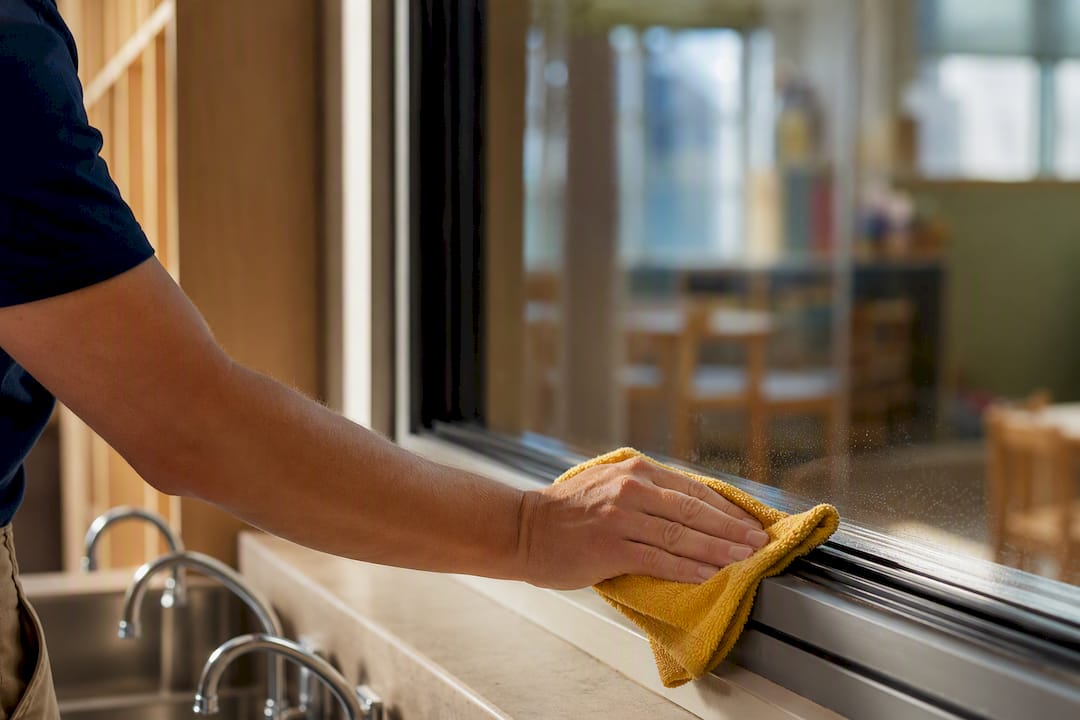
Watch for early signs of trouble: edge lifting, bubbling, or a hazy patch that won’t wipe away. Catching these early usually means a small repair instead of a full re-application. Our detailed cleaning window film guide breaks down the exact products and techniques that work best across different film types.
Build cleaning into your existing janitorial routine rather than treating it as a separate task. Most daycare cleaning crews already wipe down glass doors and low windows daily. Adding “no ammonia, no abrasive pads” to that instruction sheet is a five-minute conversation that adds years to a film’s life.
Health and Safety Compliance Specific to Daycare Environments
Daycare facilities answer to more oversight than most commercial buildings, and window film decisions need to fit inside that framework rather than run parallel to it. Licensing inspectors care about supervision sightlines, egress requirements, and whether safety glazing meets code, not just whether a room looks nice.
This is where the ANSI Z97.1 and CPSC 16 CFR 1201 standards mentioned earlier become more than a nice-to-have. Documentation showing your film meets these benchmarks can matter during a licensing review, especially if a state inspector asks how a facility manages glass hazards in child-accessible areas. Keep installer paperwork on file, not just in an email somewhere.
Privacy film needs the same scrutiny. A film that blocks outside visibility too effectively can create a supervision blind spot, which runs against most childcare licensing requirements around clear sightlines into every occupied room. This is exactly why the partial-frosting approach covered earlier isn’t just an aesthetic choice. It’s a compliance safeguard.
Fire and egress code is another consideration that gets overlooked. Security film on certain emergency-exit windows can affect how quickly glass can be broken through in an emergency, depending on film thickness and application. A professional on-site assessment should flag any window that falls under egress requirements before film goes on it, not after.
None of this replaces a facility’s existing safety protocols. Film is one layer in a much bigger compliance picture that includes fire drills, sign-in procedures, and code-required glazing. Treat it that way in any proposal or licensing conversation.
How Window Film Affects Natural Light and Comfort
The fear most operators have going into a film project is a dim, gloomy classroom. That fear is reasonable. Cheap film can absolutely do that. The fix is choosing film based on visible light transmittance, not just tint darkness.
High-VLT solar films let most daylight through while still rejecting heat and glare, which keeps a sunny classroom bright without the harsh, squinting glare that makes kids rub their eyes by 10 a.m. Choosing film that maximizes visible light while blocking heat matters specifically in daycare spaces, where a bright, cheerful environment is part of the design brief, not an afterthought.
Glare reduction is the underrated comfort win here. Anyone who’s tried to read a book to a group of toddlers with sun blasting off a whiteboard knows the problem. Solar film cuts that glare without turning the room into a cave, which is a different outcome than just closing the blinds and losing the daylight entirely.
Privacy film changes the light quality differently. Frosted film scatters light rather than blocking it, which can actually make a room feel softer and more evenly lit in some cases, though it does reduce overall brightness compared to clear glass. That’s why partial frosting, covered earlier, tends to outperform full-window frosting in nap rooms. Kids get privacy during rest time without the room going dark for the rest of the day.
Temperature comfort ties directly into behavior, too. A room that swings from cold in the morning to overheated by 2 p.m. makes it harder for kids to settle down and harder for staff to manage transitions. Film that flattens that temperature swing is doing more than saving energy. It’s making the room easier to run.
How Long Different Daycare Window Films Actually Last
Film lifespan varies more by type and installation quality than most facility managers expect. Safety and security film, when properly installed with solid edge attachment, tends to hold up for a decade or more under normal conditions. The edge-attachment method matters enormously here: anchoring film mechanically to the frame instead of relying on adhesive bonded only to the glass face dramatically improves how well it holds up on large exterior panes over time.
Solar control films generally last anywhere from 10 to 15 years depending on sun exposure and film grade. South and west-facing windows that take direct sun all day tend to show wear sooner than shaded north-facing glass. Cheaper film degrades faster, often showing bubbling or color shift within a few years, which is one more reason to ask installers about film grade rather than just price per square foot.
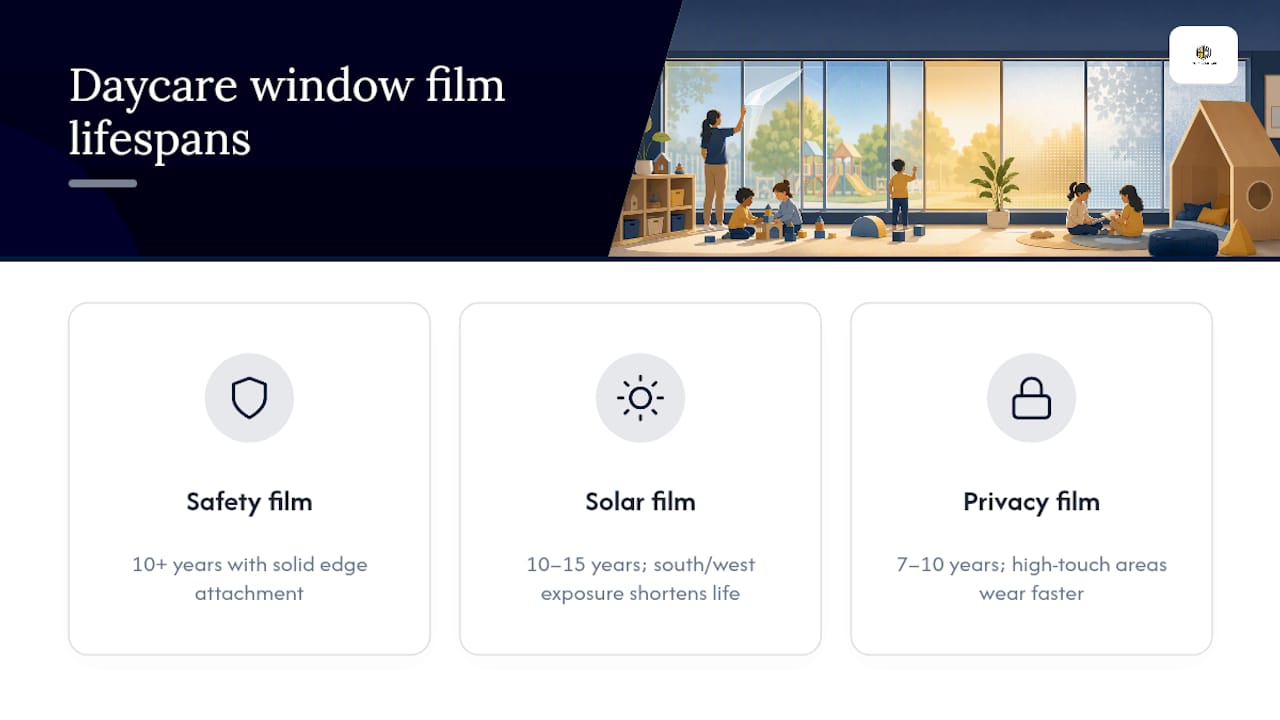
Privacy and decorative films typically have a shorter practical lifespan, often 7 to 10 years, mostly because they’re applied to high-touch areas like restroom windows and door glass where cleaning frequency and physical contact are higher.
Installation quality affects every one of these numbers more than film grade alone. A premium film installed poorly, with trapped debris or a rushed slip-solution job, can fail within a couple of years. A mid-grade film installed correctly, with proper edge sealing and drying technique, often outlasts its own warranty. That gap is exactly why the installer questions covered in the procurement checklist matter as much as the film specs themselves.
Practitioner Notes: What We See on Daycare Projects
The projects that go smoothly all share one thing: someone insisted on a proper on-site assessment before ordering film. The ones that don’t usually skipped that step to save time.
The most common mistake is mismatching film to glass condition, applying safety film to already-compromised panes or frames that can’t support proper edge attachment. Documentation gets treated as optional too often, and it’s the first thing licensing inspectors ask for.
Before signing anything, request a sample panel and a written glass assessment. It takes one visit to avoid a costly redo.
— Ron
Ready to Get Your Daycare Windows Assessed?
Some installers address the part most daycare projects get wrong: matching the right film to each window instead of quoting one product for the whole building. That means a real on-site assessment, documented recommendations tied to safety and energy goals, and a sample panel you can see and touch before committing budget to it.

Every daycare has a different mix of sun exposure, glass condition, and supervision needs, and a proposal built around your actual windows beats a generic package every time. If replacement is a better fit for a particular window than film, that gets flagged honestly during the assessment rather than glossed over. For older buildings weighing film against other efficiency upgrades, this guide to interior door efficiency is a useful companion read on where else heat loss tends to hide.
Reach out through the Tintadvantage blog to schedule an assessment and get a sample panel started for your facility.