Exterior Window Film: What Property Owners Must Know
Exterior window film is the fastest way to cut solar heat, block UV, and refresh a building’s facade without replacing glass. The short verdict: if your building runs hot, your interiors are fading, or interior access is impractical, a professional-grade, weatherable exterior film is the right move. Choose a non-metallized, exterior-rated product and an authorized installer, and you get a warranty-backed solution that performs from day one.
Here is what the specs actually look like at the top end of the market:
- Total Solar Energy Rejection (TSER): high for top-tier exterior-rated films such as Solar Gard Sentinel Plus DX 5
- UV blocking: very high in the 300–380 nm range, which is the threshold that meaningfully slows furniture and flooring fade
- Infrared rejection: up to 97% for products like the 3M Prestige Exterior Series
- Commercial warranty: 10 years when installed by an authorized dealer, as offered by the 3M Prestige Exterior line
The immediate next step for any property owner or manager is a professional site assessment. Tintadvantage (Omaha Window Tinting) evaluates substrate compatibility, confirms which film family fits your glass type and climate, and delivers a warranty-backed installation quote. That assessment costs nothing and prevents the expensive mistakes that come from picking the wrong film or an uncertified installer.
Table of Contents
- What makes exterior window film different from interior film?
- What film types and finishes are available for exterior use?
- What performance gains can you realistically expect?
- How long does exterior window film last, and what do warranties cover?
- How does an exterior film installation actually work on site?
- What does exterior window film cost, and when does it pay back?
- How do you choose the right exterior film and installer?
- How do you clean and maintain exterior window film?
- What our field experience shows about real-world performance
- Key Takeaways
- What exterior installs actually teach you
- Tintadvantage brings professional exterior film installation to the Omaha region
- Manufacturer references and useful sources
What makes exterior window film different from interior film?
Most window films are applied inside. Exterior (outside-applied) solar control film, sometimes called OSW (outside surface weatherable) film, goes on the outer face of the glass. That single difference changes everything about how the product is engineered.
Interior films use adhesives and coatings designed for a controlled, protected environment. Exterior films must survive rain, UV bombardment, temperature swings, pollution, and physical contact. Manufacturers solve this with weatherable hardcoats, adhesives formulated for outdoor bonding, and construction that resists delamination when wet.
The practical differences matter when you are choosing:
- Weatherable coatings: Exterior films carry a hardcoat layer that resists abrasion and UV degradation from the outside. Standard interior films lack this and will fail rapidly if applied to an exterior surface.
- Adhesive chemistry: Outdoor adhesives maintain bond strength through freeze-thaw cycles and prolonged moisture exposure. Interior adhesives are not rated for this.
- Non-metallized construction: Many leading exterior films avoid metal layers entirely, which eliminates corrosion risk and prevents interference with Wi-Fi, cellular, and GPS signals.
- Higher real-world TSER: Because exterior film reflects solar heat before it even passes through the glass, it achieves higher effective heat rejection than an equivalent interior film on the same pane.
Situations that specifically call for exterior film include facades where interior access is blocked by furniture, equipment, or structural elements; glass with very high solar loads where interior film alone cannot hit the TSER target; and retrofit projects where the goal is to unify a building’s appearance without replacing glazing.
What film types and finishes are available for exterior use?
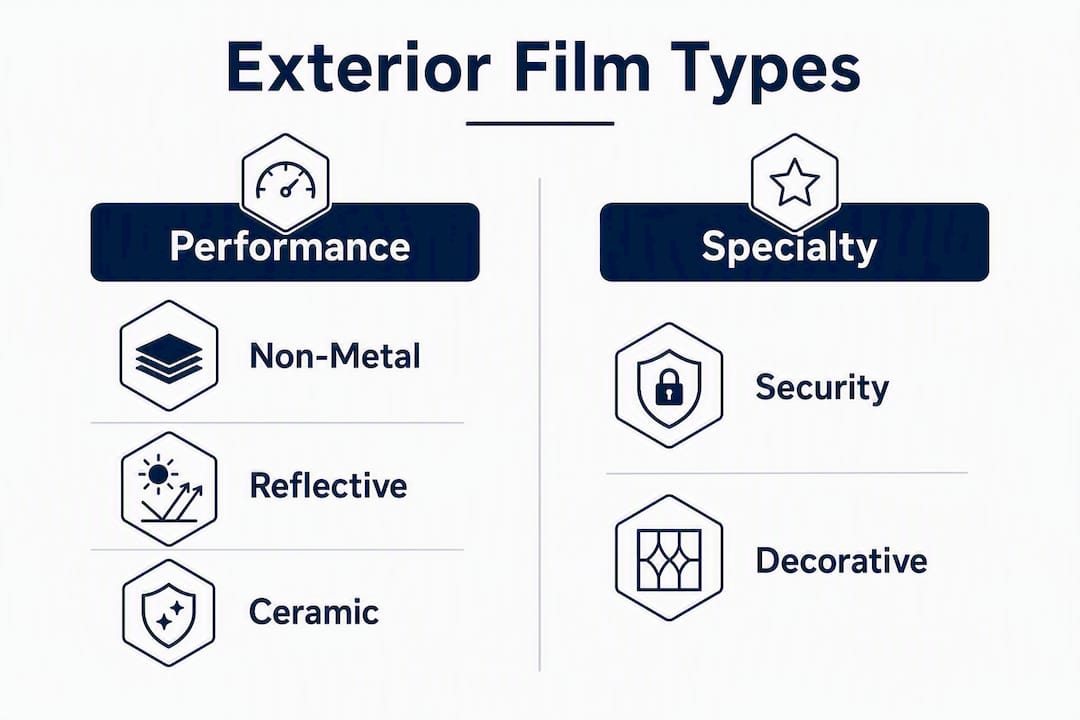
Not all exterior films look or perform the same. The five main families each suit different project goals.
| Film Family | Key Strength | Typical Use | Watch Out For |
|---|---|---|---|
| Non-metallized high-performance | Highest TSER, no signal interference, no corrosion | Commercial facades, coastal buildings | Higher upfront cost |
| Reflective/metallic | Strong heat rejection, lower cost | Industrial, budget retrofits | Corrosion risk, signal interference |
| Ceramic/IR-rejecting | Neutral appearance, high IR rejection | Residential, retail storefronts | Narrower product range for exterior |
| Safety/security exterior | Impact resistance + solar control | Ground-floor commercial, schools | Heavier film, requires robust edge seal |
| Decorative exterior | Aesthetic customization, privacy | Retail, hospitality, office facades | Lower TSER than performance films |
Non-metallized high-performance films are the workhorse of the category. Products like the 3M Prestige Exterior Series and Solar Gard Sentinel Plus use nano-technology layers instead of metal to hit top TSER numbers. No corrosion, no dropped calls, and they tend to hold their appearance longer.
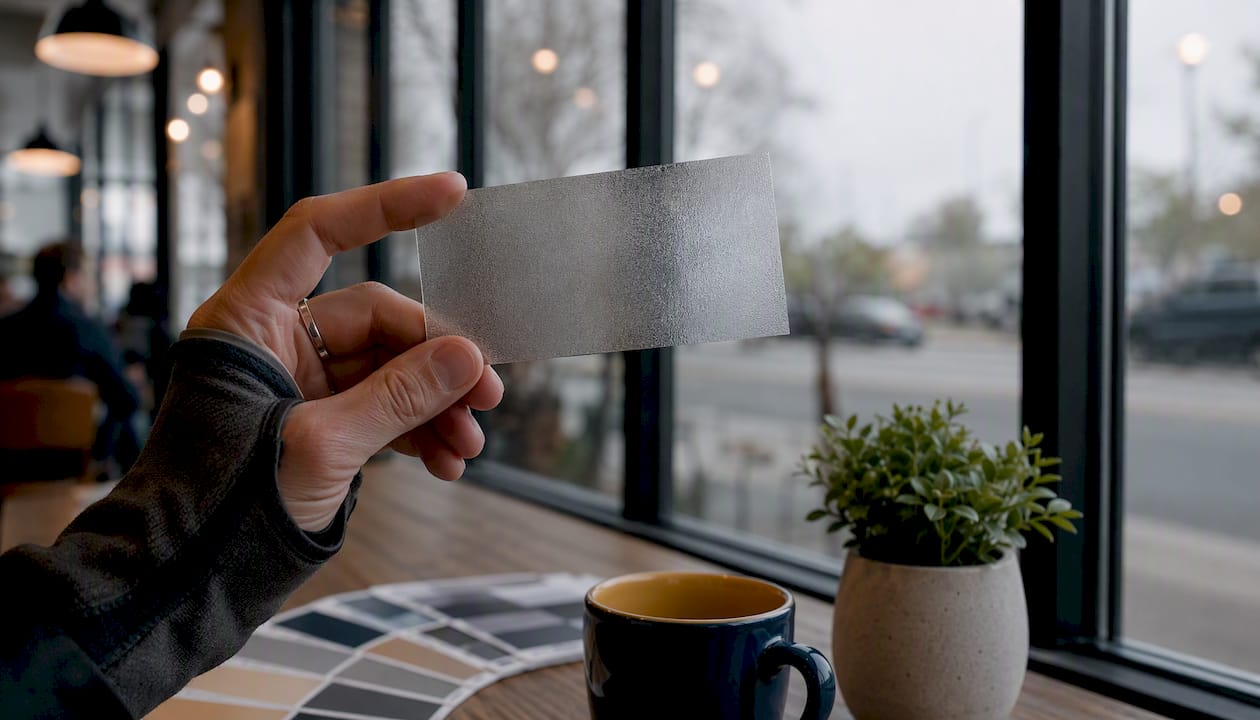
Reflective and metallic films use a thin metal layer to bounce solar energy back. They can reach TSER figures in the low-80s percent, as seen with products like UltraCool exterior silver reflective films, which advertise heat rejection up to approximately 82% and recommend edge sealing with natural cure silicone. The trade-off is a mirror-like appearance that not every building owner wants, plus the corrosion and signal concerns mentioned above.
Ceramic and IR-rejecting exterior films prioritize a neutral, low-reflectance look while still blocking significant infrared radiation. They are popular for residential projects where the homeowner wants performance without the “office building” aesthetic.
Safety and security exterior films combine a thicker, tear-resistant construction with solar control properties. They are common on ground-floor retail and schools where both forced-entry resistance and heat control matter.
Decorative exterior films serve a different master: aesthetics first. They can add privacy, branding, or visual interest to a facade, but their TSER numbers are typically modest. If heat rejection is the primary goal, a decorative film is not the right tool.
What performance gains can you realistically expect?
Understanding the spec sheet is half the battle. Here is what the key metrics actually mean for your building.
Total Solar Energy Rejection (TSER) is the percentage of total incoming solar energy (visible light, infrared, and UV combined) that the film prevents from entering the building. A TSER of 86% means only 14% of solar energy gets through. That directly reduces the heat load your HVAC system has to handle.

Solar Heat Gain Coefficient (SHGC) is the flip side: the fraction of solar energy that does pass through. Lower SHGC means less heat gain. A film with 86% TSER has an SHGC of roughly 0.14.
Infrared (IR) rejection measures how much near-infrared radiation the film blocks. IR is the part of sunlight you feel as heat on your skin. The 3M Prestige Exterior Series claims up to 97% IR rejection, which explains why rooms feel cooler even when visible light levels stay comfortable.
Visible Light Transmittance (VLT) is the percentage of visible light that passes through. Higher VLT means a brighter interior; lower VLT means more privacy and glare reduction but a darker space.
High-performance exterior films can reject up to 86% of total solar energy and block more than 99% of UV radiation, delivering measurable reductions in AC load and interior fading from a single exterior application.
| Spec Range | Expected Real-World Outcome |
|---|---|
| TSER 86% | Significant AC load reduction; noticeably cooler rooms on south and west exposures |
| UV block >99% | Furniture, flooring, and artwork fade rate drops sharply; protects materials rated for indoor use |
| IR rejection 80–97% | Reduced radiant heat near windows; occupants comfortable closer to the glass |
| VLT 20–50% | Meaningful glare reduction while maintaining usable daylight |
| VLT 5–20% | Strong privacy and glare control; interior may feel darker on overcast days |
One detail worth knowing: exterior application is the most effective method for maximizing TSER because solar heat is reflected before it even reaches the glass. An interior film with the same nominal spec will underperform an exterior film in real-world heat rejection, because some heat is already absorbed into the glass by the time the interior film acts on it.
How long does exterior window film last, and what do warranties cover?
Lifespan for professionally installed exterior film typically runs 10–15 years, though that range shifts based on several variables.
Climate is the biggest one. Buildings in high-UV regions like the Southwest face more aggressive degradation than those in the Pacific Northwest. Salt air in coastal environments accelerates adhesive breakdown on metallized films (another reason non-metallized products dominate coastal installs). Pollution and industrial fallout in urban settings can etch film surfaces over time if cleaning is neglected.
Installation quality is the other major variable. A film installed with proper surface prep, correct adhesive, and manufacturer-specified edge sealing will outlast a rushed install by years, even using the same product.
Typical warranty structures:
- Residential: Most manufacturer warranties for residential exterior film run 5–10 years and cover delamination, bubbling, and color change under normal conditions.
- Commercial: The 3M Prestige Exterior Series offers a 10-year commercial warranty when installed by an authorized dealer. That warranty is tied directly to authorized-installer status, not just the product.
- What warranties usually require: Authorized dealer installation, proper edge sealing where the manufacturer mandates it, and documentation of the install date and product used.
Warranty coverage is only as good as the installer’s authorization status. A 10-year commercial warranty from a major manufacturer becomes void the moment an uncertified installer touches the glass.
Warranty red flags to watch for before signing:
- No written warranty documentation offered upfront
- Installer cannot name their authorized-dealer relationship with the manufacturer
- Warranty language excludes edge delamination (the most common failure mode)
- No mention of edge sealing requirements in the installation plan
- “Lifetime” claims with no manufacturer backing in writing
Ask for the installer’s authorized-dealer certificate and the manufacturer’s warranty card before work begins. If either is unavailable, that is a reason to pause.
How does an exterior film installation actually work on site?
Exterior installs follow a different sequence than interior work, and the differences matter when you are evaluating bids.
- Pre-install glass inspection: The installer documents existing glass condition, checks for chips, cracks, or failed seals on insulated glass units (IGUs), and confirms the substrate is compatible with the chosen film. Applying film over a failed IGU seal voids most warranties.
- Surface preparation: The exterior glass face is cleaned thoroughly, typically with a mild detergent solution followed by a squeegee and lint-free wipe. Any silicone residue, paint overspray, or hard water deposits must be removed before film goes down.
- Adhesive selection and film cutting: Exterior-rated adhesive is applied or activated per the manufacturer’s process. Film is cut to size with a small gap at the edges to allow for thermal expansion and, where required, edge sealing.
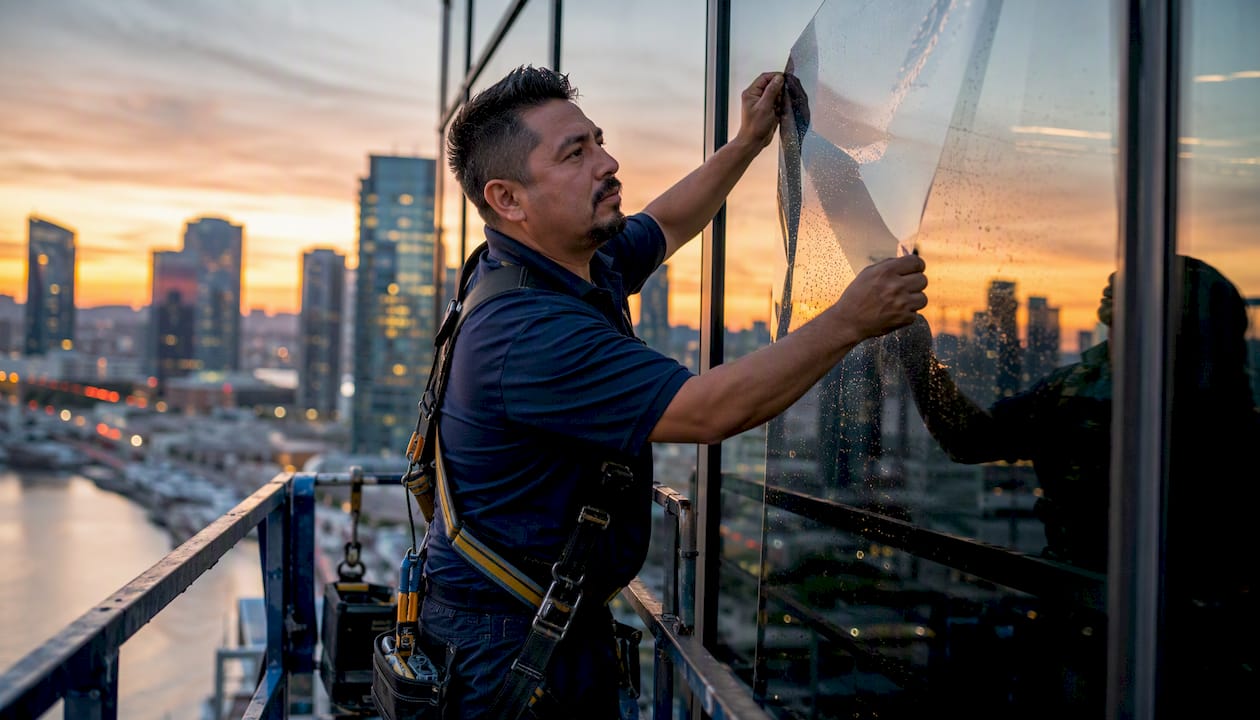
- Application and temporary support: On larger panes or elevated work, installers use temporary supports or scaffolding to hold the film in position during application. Working at height on exterior glass requires proper fall protection and equipment.
- Edge sealing: Where the manufacturer requires it, a bead of natural cure silicone is applied around the film perimeter to encapsulate the edge and prevent moisture ingress. Solar Gard’s product literature explicitly recommends this step for their exterior films. Skipping it when required is the single most common cause of premature edge delamination.
- Curing: Exterior films typically need 24–72 hours to fully cure, depending on temperature and humidity. During this window, the film should not be disturbed or cleaned.
Pro Tip: Schedule exterior installs during mild, dry weather. Temperatures below 40°F or above 90°F, high humidity, and direct midday sun during application all increase the risk of adhesion problems. A good installer will check the forecast and reschedule rather than push through bad conditions.
Authorized training matters here because exterior installs involve weatherproof adhesive chemistry, drainage details at the frame, and safety protocols that interior-only installers may not have encountered. An installer who has only done interior work is not automatically qualified for exterior applications.
Common installation red flags:
- Skipping the pre-install glass inspection
- No mention of edge sealing on a product that requires it
- Applying film in direct sunlight or extreme temperatures
- No fall protection for elevated work
- Rushing the cure period
What does exterior window film cost, and when does it pay back?
Installed costs for exterior film vary by product, building complexity, and access requirements. As a general range, residential exterior film typically runs $8–$15 per square foot installed, while commercial projects with larger panes and simpler access can come in lower on a per-square-foot basis due to economies of scale. High-performance non-metallized films and safety films sit at the upper end of those ranges.
The payback math is straightforward once you know your TSER improvement and current cooling costs.
- Establish your baseline cooling cost for the affected exposure (south and west facades drive the most load).
- Apply the TSER improvement. A film moving a window from no film (TSER ~0%) to 80% TSER is blocking 80% of the solar energy that was previously entering as heat. That does not translate to 80% lower cooling costs, because solar gain is one of several HVAC loads, but it is a meaningful reduction.
- Estimate annual savings. Tintadvantage clients have reported cooling expense reductions of 10–20% after professional installation. For a commercial building spending $30,000 annually on cooling, that is $3,000–$6,000 per year in savings.
- Calculate simple payback. Divide the installed cost by annual savings.
| Scenario | Approx. Installed Cost | Est. Annual Savings | Simple Payback |
|---|---|---|---|
| Residential sunroom | $8–$15 per sq ft installed | — | 4–8 years |
| Small office | $8–$15 per sq ft installed | — | 3–6 years |
| Retail storefront | $8–$15 per sq ft installed | — | 3–6 years |
The 3M Prestige Exterior Series claims the potential to become carbon negative relatively quickly for large commercial installs where HVAC reductions are substantial. That is an aggressive claim, but it reflects the scale of energy impact possible on high-solar-load facades.
For property managers, the comparison that matters is film cost versus glazing replacement. New commercial glazing runs $50–$150 per square foot or more installed. Exterior film at $8–$15 per square foot, with a 10-year warranty, is often the fastest retrofit with measurable ROI. Pairing window film with other building envelope improvements can push total energy savings higher still.
How do you choose the right exterior film and installer?
The wrong film or a bad install costs more to fix than it would have cost to get right the first time. Use this checklist before committing.
Film evaluation checklist:
- Define your primary goal: heat rejection, UV protection, glare control, privacy, security, or aesthetics
- Identify your climate: high UV, coastal salt air, freeze-thaw cycling, or industrial pollution each favor different film families
- Set a TSER target based on your cooling costs and comfort complaints
- Confirm VLT range that keeps interiors bright enough for occupants
- Decide whether metallized or non-metallized construction fits your building (coastal and tech-heavy buildings: go non-metallized)
- Verify the film carries an exterior (OSW) rating from the manufacturer, not just a general “solar control” label
Questions to ask every installer:
- Are you an authorized dealer for the film you are recommending, and can you show documentation?
- What is the manufacturer’s warranty term for this product in a commercial/residential application?
- Does this film require edge sealing, and is that included in your quote?
- Have you installed this specific film on this glass type before?
- Can you provide a sample installation on a small test pane before full commitment?
- What is your maintenance recommendation after installation?
- What happens if I see edge lift or delamination within the warranty period?
Red flags that should stop a conversation:
- Installer recommends a metallized film for a coastal or corrosion-prone environment without explaining the trade-offs
- No written warranty terms available before signing
- Refusal to do a small test area on unfamiliar glass
- Quote does not itemize edge sealing separately (so you cannot tell if it is included)
- Claims of “lifetime performance” with no manufacturer documentation to back it
How do you clean and maintain exterior window film?
Exterior film takes more abuse than interior film, so maintenance is not optional. The good news: the routine is simple.
Safe cleaning practices:
- Use a mild, non-abrasive soap solution and a soft microfiber cloth or rubber squeegee
- Rinse with clean water before wiping to remove grit that could scratch the hardcoat
- Avoid ammonia-based cleaners, solvent-based products, and abrasive pads
- Keep high-pressure washers at least 12 inches from the film edge and never aim directly at seams or edge-sealed borders
- Clean in the early morning or evening when the glass is cool; cleaning hot glass in direct sun can leave streaks and stress the adhesive
Spotting early failure:
- Edge lift: A small gap or bubble forming at the film perimeter. Photograph it immediately and contact your installer. Caught early, edge lift is often repairable without full replacement.
- Delamination: Cloudy or milky patches in the film body, usually caused by moisture ingress. This is a warranty claim situation.
- UV degradation: Yellowing or color shift in the film. On a quality exterior film with a proper hardcoat, this should not appear within the warranty period.
- Scratches: Surface scratches on the hardcoat that do not penetrate the film body are cosmetic. Deep scratches that compromise the film’s optical clarity warrant replacement of that pane’s film.
Pro Tip: Coastal buildings should inspect film edges every six months. Inland buildings in moderate climates can get away with annual checks. After any severe storm, do a quick visual scan of all film edges before the next cleaning cycle.
Document your cleaning schedule and any observations in writing. If you ever need to make a warranty claim, that maintenance log is evidence that you held up your end of the warranty conditions.
What our field experience shows about real-world performance
Lab specs and field results do not always match, and the gap is almost always explained by installation quality, not the film itself.
Tintadvantage clients have reported cooling expense reductions of 10–20% after professional installation, with measurable improvements in indoor comfort and reduced HVAC load. These results are consistent with what high-performance exterior film manufacturer specs predict, provided the installation is done correctly. Surface prep, adhesive selection, edge sealing, and curing time are not steps you can rush without paying for it later.
The single biggest variance between a lab TSER number and what a building owner actually experiences is installer technique. A film rated at 86% TSER, installed with poor surface prep and no edge seal on a product that requires it, will underperform and fail early. The same film, installed by a trained, authorized professional, will hit close to its rated numbers and hold them for a decade.
Professional installation is not a premium add-on. It is the variable that determines whether a high-performance film delivers its rated TSER for 10 years or fails at the edges in three.
For commercial property managers, the practical takeaway is this: the film brand matters, but the installer’s authorization status and technique matter more. Tintadvantage’s approach starts with a thorough pre-install assessment, confirms substrate compatibility, and documents glass condition before any film goes down. That documentation protects the client if a warranty claim ever becomes necessary.
Key Takeaways
Exterior-rated window films, installed by an authorized professional, deliver the highest TSER and UV blocking available without replacing glass, and they carry manufacturer warranties that protect that performance for up to a decade.
| Point | Details |
|---|---|
| Exterior vs. interior film | Exterior films use weatherable coatings and outdoor adhesives; standard interior films will fail rapidly if applied outside. |
| Top performance specs | Leading products reach up to 86% TSER, over 99% UV blocking, and up to 97% IR rejection. |
| Warranty requires authorization | Commercial 10-year warranties, such as those from 3M’s Prestige Exterior line, are only valid when installed by an authorized dealer. |
| Edge sealing is non-negotiable | Manufacturers like Solar Gard specify natural cure silicone edge sealing; skipping it is the most common cause of early failure. |
| Tintadvantage for local installs | Tintadvantage provides authorized exterior film installation in the Omaha region, with cooling savings of 10–20% reported by clients. |
What exterior installs actually teach you
The conventional wisdom in the window film industry is that product selection is the hard part. After years of exterior installs, the reality is almost the opposite: the film choice is usually straightforward once you know the building’s solar load, climate, and aesthetic goals. The hard part is everything that happens before and after the film goes on the glass.
Old glazing is the variable that catches installers off guard most often. A building with 20-year-old frames may have drainage details that no longer work, silicone that has shrunk away from the frame, or glass that has micro-cracks invisible until you clean it properly. Applying a premium exterior film over compromised glass is a waste of money. The right move is to document pre-install glass condition with photographs, flag any issues to the property owner before starting, and let the owner decide whether to address the underlying problem first.
Salt exposure is the other underestimated factor. Coastal and near-coastal buildings in the mid-Atlantic and Gulf Coast regions see adhesive breakdown on metallized films within a few years if the wrong product is specified. Non-metallized films are not just a preference in those environments; they are the only sensible choice.
The installer workflow tweak that makes the biggest difference is scheduling. Moderate temperatures, low humidity, and overcast skies are ideal. Installers who push through a 95°F afternoon in direct sun to hit a deadline are setting up a warranty claim. The best installs happen in the early morning, in spring or fall, with a forecast that holds dry for 48 hours after application.
Use the installer checklist from the section above when comparing bids. The questions about edge sealing, authorized-dealer status, and test pane willingness will tell you more about an installer’s competence than any portfolio photo.
Tintadvantage brings professional exterior film installation to the Omaha region
If you have read this far, you know what separates a high-performance exterior film install from a mediocre one: the right product, an authorized installer, proper edge sealing, and documented warranty terms. That is exactly what Tintadvantage delivers for residential and commercial properties across the Omaha area.

Tintadvantage installs the full range of exterior film types: solar and UV control films, ceramic films, safety and security films, and decorative exterior options. Every project starts with a no-cost site assessment that confirms substrate compatibility, identifies any pre-existing glass issues, and matches the right film to your building’s solar exposure and aesthetic goals. Clients consistently report cooling expense reductions of 10–20% after installation, with noticeably cooler interiors. Those results come from precise installation and quality craftsmanship, not just the film brand.
Request your on-site estimate from Tintadvantage today and get a warranty-backed quote for your property.
Manufacturer references and useful sources
Verifying specs directly from manufacturer product pages protects you from outdated or inflated numbers circulating on retail listings and general review sites. These are the primary sources used throughout this article.
Manufacturer product pages:
- 3M Prestige Exterior Series product page — IR rejection specs, non-metallized construction details, and commercial warranty terms
- 3M Prestige Exterior Series 20 (36 in roll) — product-level specs for the lighter VLT variant
- 3M Prestige Exterior Series 90 (72 in roll) — high-VLT variant specs and roll dimensions
Authorized installer and dealer programs:
| Manufacturer | Where to verify dealer status | Warranty condition |
|---|---|---|
| 3M | 3M authorized dealer locator on 3m.com | Commercial 10-year warranty requires authorized installation |
| Solar Gard | Solar Gard dealer network page | Warranty terms tied to authorized installer documentation |
| LLumar / Vista | LLumar dealer locator | Dealer-exclusive warranty programs vary by product line |
Before any exterior film installation, ask your installer for their authorized-dealer certificate in writing. A manufacturer warranty is only enforceable if the installer’s authorization status is documented at the time of install. Verbal assurances are not sufficient.
Retail marketplaces and general catalog sites carry exterior film SKUs, but product descriptions on those platforms often omit critical details like OSW rating, edge-seal requirements, and warranty eligibility. Always cross-reference specs against the manufacturer’s own product page before committing to a purchase or an install.