
Frosted Window Film for Offices: Privacy Without Losing Daylight
For most offices, a professional-grade frosted or etched-style window privacy film applied by a certified installer is the right call. It gives you genuine visual privacy, keeps natural light flowing, and comes with manufacturer-backed warranties that DIY kits simply cannot match. Contact Tintadvantage (Omaha Window Tinting) for an onsite assessment and quote before you commit to any product or pattern.
Table of Contents
- What types of frosted window film work best for offices?
- Where should you apply frosted film in an office?
- What benefits do you get beyond privacy?
- Professional installation vs. DIY: which should you choose?
- What does office frosted film cost, and how long does it take?
- How do you maintain frosted film and how long does it last?
- What a certified installation actually looks like
- Key Takeaways
- Why the “just buy a kit” instinct costs you more than you think
- Tintadvantage brings certified office film installation to your door
- Useful sources for further research
What types of frosted window film work best for offices?
Not every frosted film is the same product, and the differences matter more than most spec sheets let on.
Full etched-style frosted film mimics sandblasted glass across the entire pane. It works well for restroom doors, private offices, and any glass where you want complete visual separation. Full frosted decorative film transmits a high amount of daylight while blocking direct view, which is why it has become the default for office partitions.
Matte frost film is a softer, more diffused look. Products like Madico Frost Matte carry a visible light transmission of 67% and UV rejection of ≥ 99%, making them a practical choice when glare control matters alongside privacy. White frost films designed for interior use can run around 55% VLT, which suits spaces where you want a denser, more opaque appearance.
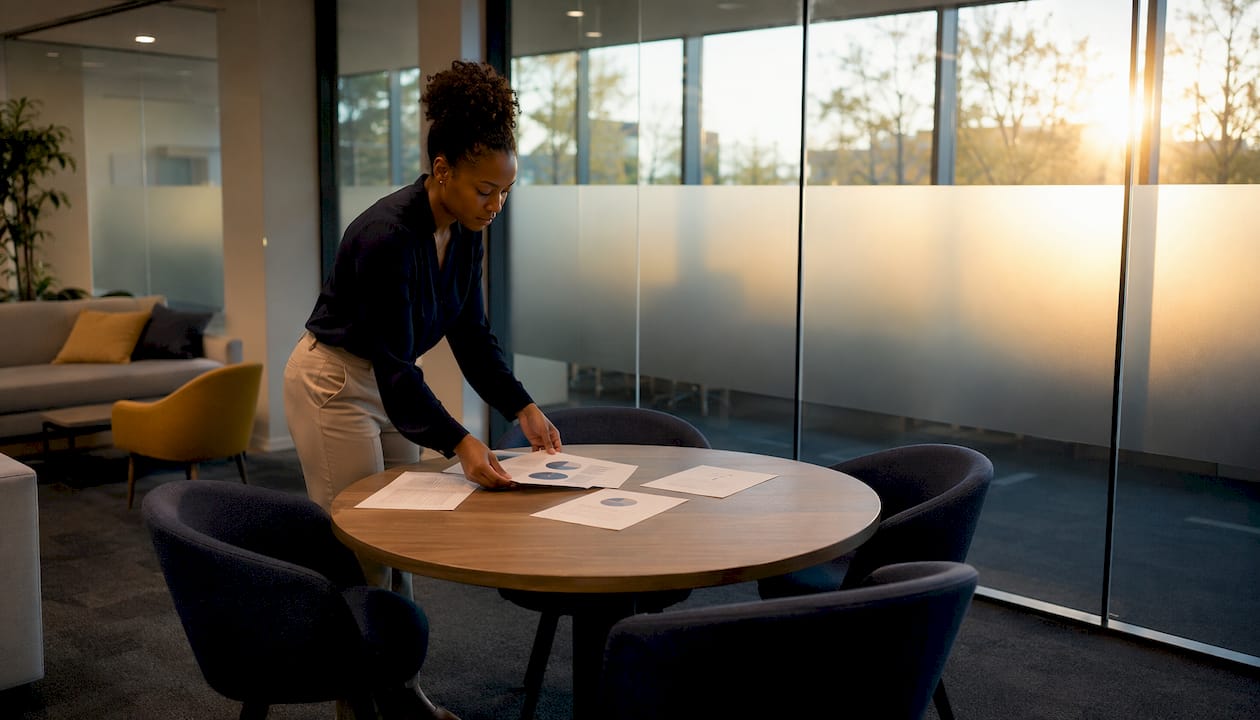
Gradient and ombré film transitions from frosted at the bottom to clear at the top (or vice versa). Conference rooms benefit most here: occupants get seated privacy while standing visitors can still see in at head height, preserving some visual openness.
Dot, line, and geometric decorative films add pattern without full opacity. They work well on reception glass and open-plan partitions where you want texture and visual interest rather than complete screening.
Die-cut and custom-branded film is the most underused option in commercial fit-outs. Installers can cut logos, wordmarks, or geometric patterns to precise tolerances, integrating environmental branding directly into glass without the cost of custom-fabricated etched panels.
On installation method: permanent pressure-sensitive adhesive films are the standard for long-term commercial applications. Removable or static-cling films exist, but they are better suited to temporary installations or leased spaces where you cannot alter the glass permanently.
Pro Tip: If your priority is daylight retention in a conference room, choose an eye-level band (roughly 36–60 inches from the floor) rather than full-height frosting. You get seated privacy for every occupant while the clear glass above and below keeps the room feeling open.
Where should you apply frosted film in an office?
Placement determines whether a film solution looks intentional or like an afterthought.
Conference rooms are the highest-value application. Full-height frosting on glass walls and doors eliminates visual distraction during meetings and protects sensitive discussions. An eye-level privacy band on partitions is a common and effective compromise on open floors: it screens seated occupants without making the room feel closed off.
Reception and front-desk glass benefits from partial frosting or a decorative pattern that signals professionalism without blocking the receptionist’s sightlines. A lower-third frost with a clear upper panel is a clean, practical solution here.
Private offices with glass walls often use full-height film on the lower two-thirds, leaving a clear band at the top. This maintains natural light transfer between spaces while giving the occupant genuine privacy.
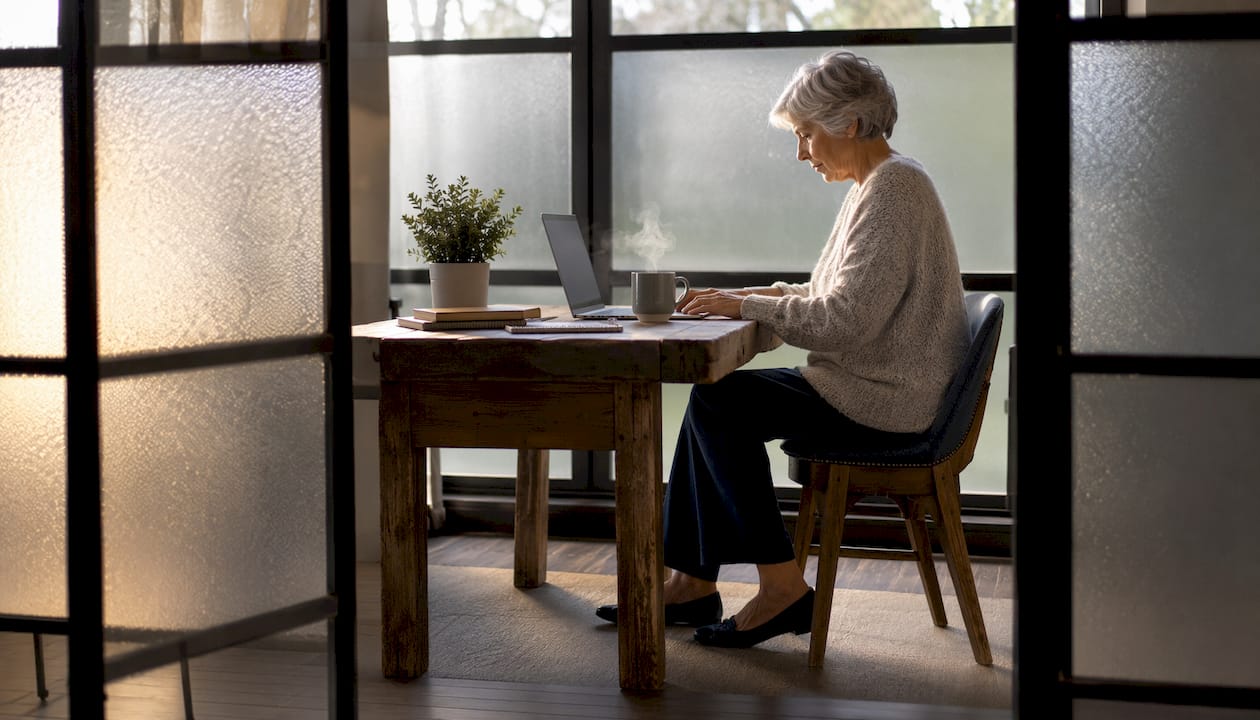
Internal partitions and restroom doors are straightforward full-frost applications. The sandblasted/etched-glass look from a quality film is nearly indistinguishable from actual etched glass at normal viewing distances.
Exterior storefront glazing is where solar performance specs matter more. A film with meaningful TSER (total solar energy rejected) numbers reduces heat load while maintaining street visibility from inside.
One design note worth keeping in mind: wherever you apply frosting near fire exits or corridor intersections, maintain clear sightlines at eye level for safety and building-code compliance. A well-placed band that respects those sightlines is both a design choice and a practical requirement.
What benefits do you get beyond privacy?
Privacy is the reason most facility managers request a quote. The secondary benefits are what make the budget conversation easier.
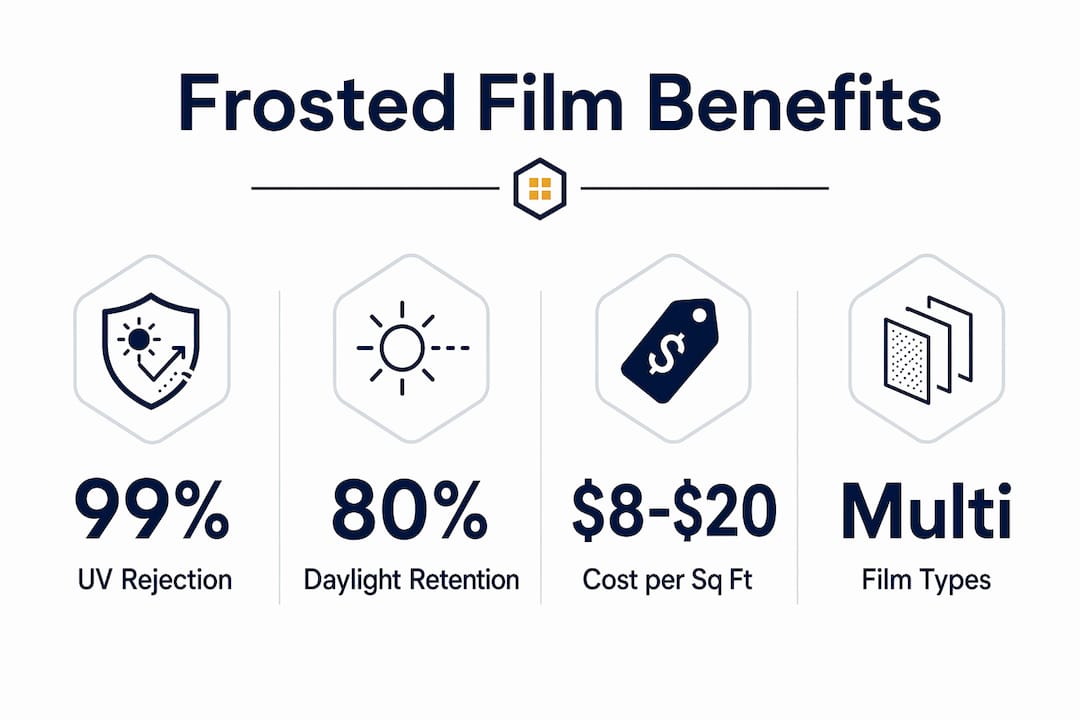
- Daylight retention: Full frosted film preserves over 80% of visible light transmission, outperforming blinds and opaque partitions by a wide margin.
- UV protection: Professional-grade films block over 99% of UV rays, which directly reduces fading on flooring, furniture, and artwork. That alone extends the replacement cycle on interior furnishings.
- Glare reduction: Madico Frost Matte, for example, delivers 25% glare reduction alongside its privacy function.
- Thermal management: A TSER of 31% and IR rejection of 38% (per Madico Frost Matte specs) contribute to reduced heat gain, which supports HVAC efficiency in sun-exposed offices.
- Branding: Die-cut frosted film turns glass partitions into a branding surface at a fraction of the cost of custom-fabricated etched glass.
- Aesthetics: A frosted film finish looks more considered than a pulled blind and signals a professional environment to clients and visitors.
| Performance Metric | Madico Frost Matte |
|---|---|
| Visible Light Transmitted | 67% |
| UV Rejection | ≥ 99% |
| Total Solar Energy Rejected | 31% |
| IR Rejection | 38% |
| Glare Reduction | 25% |
UV rejection ≥ 99% is a documented specification for professional-grade frosted films, meaning virtually all UV-driven fading of furnishings and flooring is eliminated after installation.
Compared to blinds, frosted film requires no daily operation, no mechanical maintenance, and no replacement of broken slats. It is a one-time installation that works passively, every day.
Professional installation vs. DIY: which should you choose?
For a commercial office, hire a certified professional installer. The reasoning is straightforward: glass type compatibility, warranty preservation, and finish quality all depend on getting the application right the first time.
3M recommends certified dealer installers to retain both manufacturer film warranties and labor warranties, and to ensure correct product selection for complex glazing. That recommendation reflects a real risk: applying the wrong film to tempered, laminated, or insulated glass units can cause thermal stress cracking or adhesion failure.
The professional workflow typically runs: onsite consultation and glass assessment, precise measurements, product selection matched to glass type and privacy need, surface preparation, controlled application with edge finishing, and a post-install inspection. A good installer catches problems before they become warranty claims.
DIY kits are available and can work on simple, flat, single-pane glass in low-stakes applications. The trade-offs are real, though: bubbles, peeling edges, and misaligned patterns are common on first attempts, and any installation defect voids the manufacturer warranty.
Pro Tip: Ask any installer for their manufacturer certification before signing a contract. A certified installer can offer a labor warranty on top of the film manufacturer’s product warranty. That combination is worth more than a lower per-square-foot price from an uncertified contractor.
| Factor | Professional Installation | DIY Kit |
|---|---|---|
| Warranty coverage | Manufacturer film + labor warranty | Film warranty only (often voided by DIY) |
| Glass compatibility check | Yes, onsite assessment included | Buyer’s responsibility |
| Finish quality | Controlled, edge-finished | Variable; bubbles and peeling common |
| Custom cutting/patterns | Yes, precise tolerances | Limited; manual cutting required |
| Correct film for glass type | Verified by certified installer | Risk of mismatch |
| Long-term cost | Higher upfront, lower rework risk | Lower upfront, higher rework risk |
What does office frosted film cost, and how long does it take?
Professional installation of office frosted film typically runs in the range of $8–$20 per square foot, depending on film grade, pattern complexity, glass height, site access, and whether old film needs to be removed first. Custom die-cut branded patterns sit at the higher end. Standard matte frost on flat partitions sits toward the lower end.
That per-square-foot figure covers material, labor, edge finishing, and cleanup. It does not include structural modifications or glass repair.
For timeline, a small project (one conference room or a handful of doors) can go from onsite measurement to completed installation in under a week. Larger phased projects across a full floor or building take longer, primarily due to scheduling and product lead times.
Typical procurement steps:
- Onsite measure and consultation: 1–2 hours; usually free with a quote
- Sample review and product approval: 2–5 business days
- Scheduling and product lead time: 3–10 business days depending on custom cutting
- Installation: Half a day to a full day for most single-floor projects
- Post-install QA and touch-up: Same day or within 48 hours
For glass interior doors with decorative film, the design integration can be worth exploring alongside glass door aesthetics to make sure the film pattern complements the door hardware and frame finish.
How do you maintain frosted film and how long does it last?
High-quality professional-grade frosted films are rated for 10 or more years, though actual longevity depends on the cleaning regimen and whether the film was installed correctly in the first place.
Cleaning rules that matter:
- Use a soft cloth or squeegee with a mild, non-abrasive cleaner
- Never use ammonia-based cleaners (Windex and most glass sprays contain ammonia); ammonia degrades the film surface and causes premature hazing
- Avoid abrasive scrubbers or razor blades on the film surface
- Clean as needed; there is no minimum frequency, but quarterly is a reasonable baseline for office environments
Troubleshooting common issues:
- Small bubbles shortly after install: Normal during the curing period (up to 30 days). They typically disappear as the adhesive fully bonds.
- Persistent bubbles or lifting edges after curing: Usually indicate a surface prep issue or incorrect film for the glass type. Contact your installer; this is typically covered under a labor warranty.
- Peeling corners: Often caused by ammonia cleaners or physical impact. Partial repair is possible, but widespread peeling usually means replacement.
Film should be replaced rather than repaired when peeling or hazing covers more than a small area. Manufacturer warranties typically cover defects in materials and adhesion; they do not cover damage from improper cleaning or physical abuse.
What a certified installation actually looks like
A mid-size professional services firm needed privacy on eight glass-walled conference rooms without darkening the floor. The solution was a full-height etched-style frosted film on the lower 60 inches of each partition, with a clear band above to maintain light transfer and sightlines from the corridor.
Film selected was a professional-grade matte frost with ≥ 99% UV rejection and 67% visible light transmission. Installation across all eight rooms was completed in a single day. Post-install, occupants reported an immediate reduction in meeting-room glare and a noticeable improvement in perceived privacy during client calls.
The UV protection spec alone justified the investment for the facilities team: furnishings and flooring in sun-exposed conference rooms had been fading visibly. With UV rays blocked at ≥ 99%, that replacement cycle extends significantly.
Key Takeaways
Professional frosted window film is the most cost-effective way to add privacy to office glass while preserving natural light, UV protection, and a polished aesthetic backed by installer warranty.
| Point | Details |
|---|---|
| Film type for most offices | Etched-style or matte frost film preserves over 80% of daylight while blocking direct view. |
| UV and performance specs | Professional films reject ≥ 99% of UV rays, reducing furnishing fade and glare simultaneously. |
| Installation decision | Hire a certified installer to preserve manufacturer and labor warranties; DIY voids most coverage. |
| Cost and timeline | Expect $8–$20 per sq ft installed; most single-floor projects complete within one to two weeks. |
| Tintadvantage next step | Contact Tintadvantage (Omaha Window Tinting) for a certified onsite quote and film recommendation. |
Why the “just buy a kit” instinct costs you more than you think
Most facility managers who call Tintadvantage after a failed DIY attempt say the same thing: the film looked fine for the first few months, then the edges started lifting. By that point, the warranty was void, the glass needed cleaning, and the rework cost more than a professional install would have from the start.
The real issue is not skill. It is product selection. Tempered glass, insulated glass units, and laminated safety glass each have different thermal and adhesion characteristics. Applying a standard consumer film to the wrong substrate is not just an aesthetic problem; it can cause thermal stress in sealed units. A certified installer assesses the glass before recommending a product. That step does not exist in a kit.
There is also the pattern question. An eye-level band that is 2 inches off-level, or a die-cut logo that is slightly misaligned, reads as unprofessional in a client-facing space. Precision matters in a way that is hard to achieve without the right tools and experience.
The other thing worth saying: frosted film is not a commodity. The difference between a $2-per-square-foot consumer roll and a professional-grade product with documented UV rejection and a 10-year rating is real and measurable. Spec the product, not just the look.
Tintadvantage brings certified office film installation to your door
If you are ready to move from research to results, Tintadvantage (Omaha Window Tinting) handles the full process: onsite glass assessment, product selection matched to your privacy and performance needs, precise installation by certified technicians, and manufacturer-backed warranties on both film and labor. The company serves commercial and residential clients with a focus on measurable outcomes, including UV protection, glare reduction, and energy savings.
Whether you need a single conference room frosted or a full-floor privacy film project, the process starts with a no-obligation onsite quote. Request your assessment and get a film recommendation specific to your glass type, layout, and budget.
Useful sources for further research
- Madico Frost Matte product specs: Full performance data including VLT, UV rejection, TSER, and IR rejection for a professional-grade frosted film.
- 3M Building Window Solutions design page: Manufacturer guidance on certified installation, product selection, and warranty preservation for commercial glazing.
- Reflectiv frosted window film overview: Design and application guidance for frosted film on glass partitions, including eye-level band strategies.
- Nanotech Frost Matte product page: Spec and aesthetic reference for interior-application frosted films with a sandblasted appearance.
- Tintadvantage (Omaha Window Tinting): Primary contact for certified office window film installation, onsite quotes, and local service in the Omaha area.