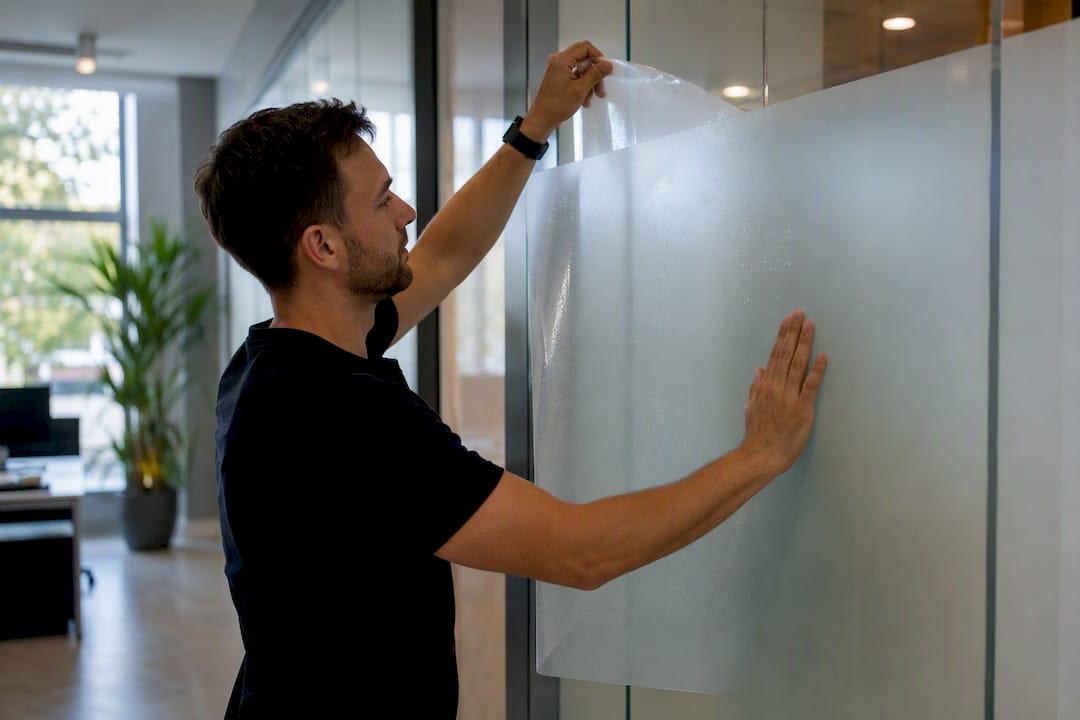
The Best Privacy Film Options for Glass Partitions
For most office and home glass partitions, frosted or decorative film gives you reliable 24-hour privacy while still letting daylight pour through. That’s the short answer. Reflective (one-way) film only works during the day, since interior light brighter than exterior light flips the effect at night and turns your glass into a lit-up display case. Blackout film is your pick when you need total opacity, day or night, no exceptions.
A representative frosted product on the market advertises roughly 90% opacity with filtered light still passing through, and that VLT range is a good benchmark to shop against.
Here’s your quick checklist before you buy or call anyone:
- Measure your pane (height, width, and note if it’s tempered or low-E glass).
- Decide static-cling (renter-friendly) or adhesive (permanent, cleaner long-term finish).
- If the partition is large or the glass is specialty-coated, request a free estimate from Omaha Window Tinting instead of guessing.
Pro Tip: If you’re torn between two film types, pick based on when you need privacy most. Daytime-only office? Reflective works. Bathroom or bedroom partition? Go frosted or blackout.
Key Takeaways
Frosted or decorative film delivers 24-hour privacy for glass partitions without sacrificing daylight, while reflective film only works during daytime hours.
| Point | Details |
|---|---|
| Default to frosted/decorative | Choose frosted or patterned film for around-the-clock privacy that still lets light through. |
| Match film to schedule | Use reflective film only for daytime privacy needs; it reverses once interior lights are on at night. |
| Expect temporary hazing | Adhesive installs show a white haze during the wet-application cure period that clears within days. |
| Hire pros for tricky glass | Large panes, tempered glass, or low-E coatings call for professional installation to protect warranties. |
| Tint Advantage handles complex installs | Omaha Window Tinting offers custom measurement, wet-method installation, and warranty-backed privacy film for partitions. |
Table of Contents
- What Types of Glass Partition Privacy Film Should You Consider?
- How Do You Install Privacy Film on a Glass Partition?
- How Do You Choose the Right Privacy Film for Your Partition?
- Is DIY or Professional Installation Better for Your Budget and Timeline?
- What Are the Real Limitations of Privacy Film?
- Where Can You Buy Privacy Film, and What’s Your Next Step?
- Why Decorative Film Wins Most Partition Projects
- Get a Custom Privacy Film Install From Omaha Window Tinting
- Sources
What Types of Glass Partition Privacy Film Should You Consider?
Four categories cover almost every situation you’ll run into, and each one trades off privacy, light, and view-through differently.
- Frosted/opaque film diffuses light evenly and blocks clear sightlines in both directions, day and night. This is the workhorse choice for bathrooms, shower enclosures, and interior office walls.
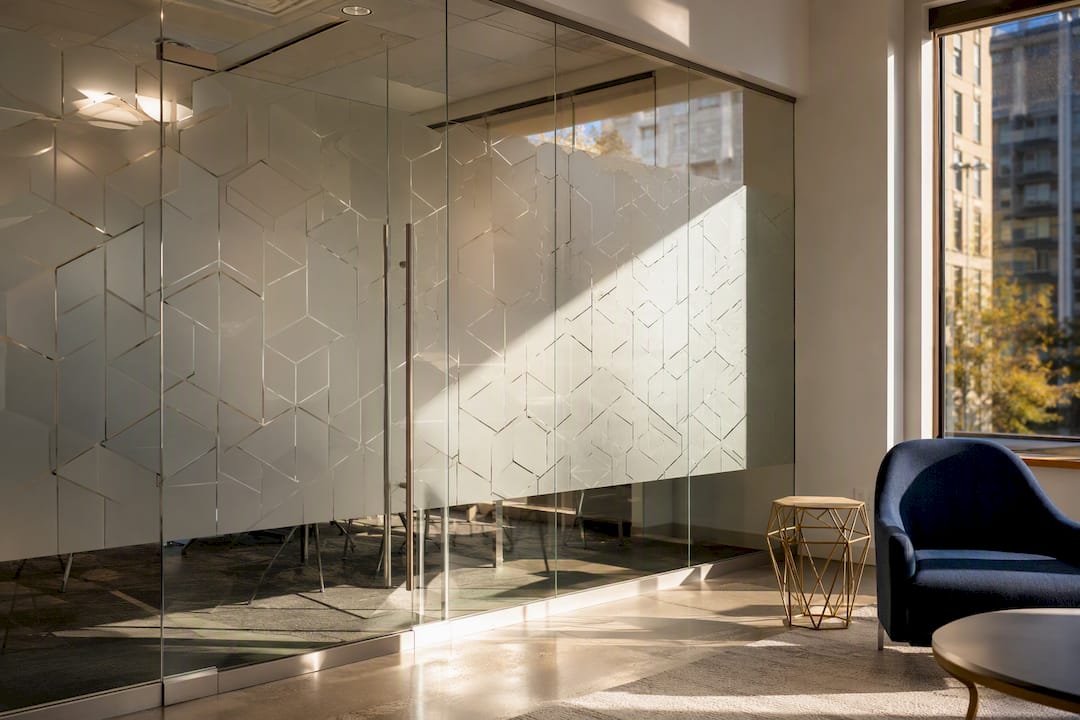
- Decorative patterned film obscures partially, often in stripes, dots, or etched-glass designs, giving you privacy plus a design statement. Purlfrost’s PO6 partition pattern is a good example, though the manufacturer notes some printed designs only deliver daytime privacy and recommends full frosted coverage if you need round-the-clock coverage.
- Reflective/one-way film mirrors the brighter side during daylight hours, so people outside see their own reflection while you see out clearly.
- Blackout/whiteout film blocks all light transmission and all sightlines, useful for storage rooms or media walls, less useful anywhere you still want natural light.
VLT (visible light transmission) is the number that separates these. Lower VLT means more privacy but a dimmer room; higher VLT keeps things bright but sacrifices some opacity.
Statistic Callout: One-way films flip completely once the sun goes down, because the physics runs on relative brightness, not glass coating alone. Once your lights are on and it’s dark outside, anyone on the other side of the glass can see straight in.
How Do You Install Privacy Film on a Glass Partition?
You’ve got three real paths here, and each one fits a different situation.
- Static-cling film uses no adhesive at all. It clings to glass with static and water tension, which makes it the go-to for renters or anyone who wants to reposition or remove the film without residue.
- Adhesive (peel-and-stick) film bonds permanently and gives a cleaner, more polished look for the long haul, but it demands careful technique. Skip a step and you’ll trap bubbles under the surface.
- Professional installation is worth the call for large panes, tempered or low-E glass, or partitions with awkward angles. Pros know how to avoid warranty complications and heat-buildup issues that DIY jobs sometimes trigger, and Tint Advantage’s low-E film guidance covers exactly why substrate matters here.
Pro Tip: Adhesive films go on wet. Clean the glass thoroughly, spray it down with soapy water so the film can slide into position, and expect a temporary white haze in the adhesive that clears up as the moisture evaporates over the following days.
How Do You Choose the Right Privacy Film for Your Partition?
Start with your privacy goal. Do you need coverage only during business hours, or around the clock? That single question eliminates half your options immediately.
From there, work through this list:
- VLT target: lower numbers for maximum privacy, higher for a brighter room.
- View-through needs: some spaces (a home office, say) benefit from partial patterns that still let you glance through.
- Permanence: adhesive if you’re staying put, static-cling if you might move the film later.
- Cleaning and maintenance: textured or frosted finishes hide fingerprints better than glossy patterns.
- Budget and warranty: DIY rolls cost less upfront, but professional installs often carry a materials-and-labor warranty.
Match the use-case to the film. Conference rooms usually do best with frosted or lightly patterned film, since it reads as intentional design rather than an afterthought, and conference room privacy film is a solid reference point for that. Bathrooms and shower enclosures call for full frosted coverage. Storefronts benefit from decorative branding patterns. Home office partitions often do well with a partial obscure pattern that keeps some visual connection to the rest of the house.
If you want a custom look, decorative prints replicate etched or sandblasted glass; 3M’s crystal glass finishes are a well-known example of that durable, design-forward category.
Is DIY or Professional Installation Better for Your Budget and Timeline?
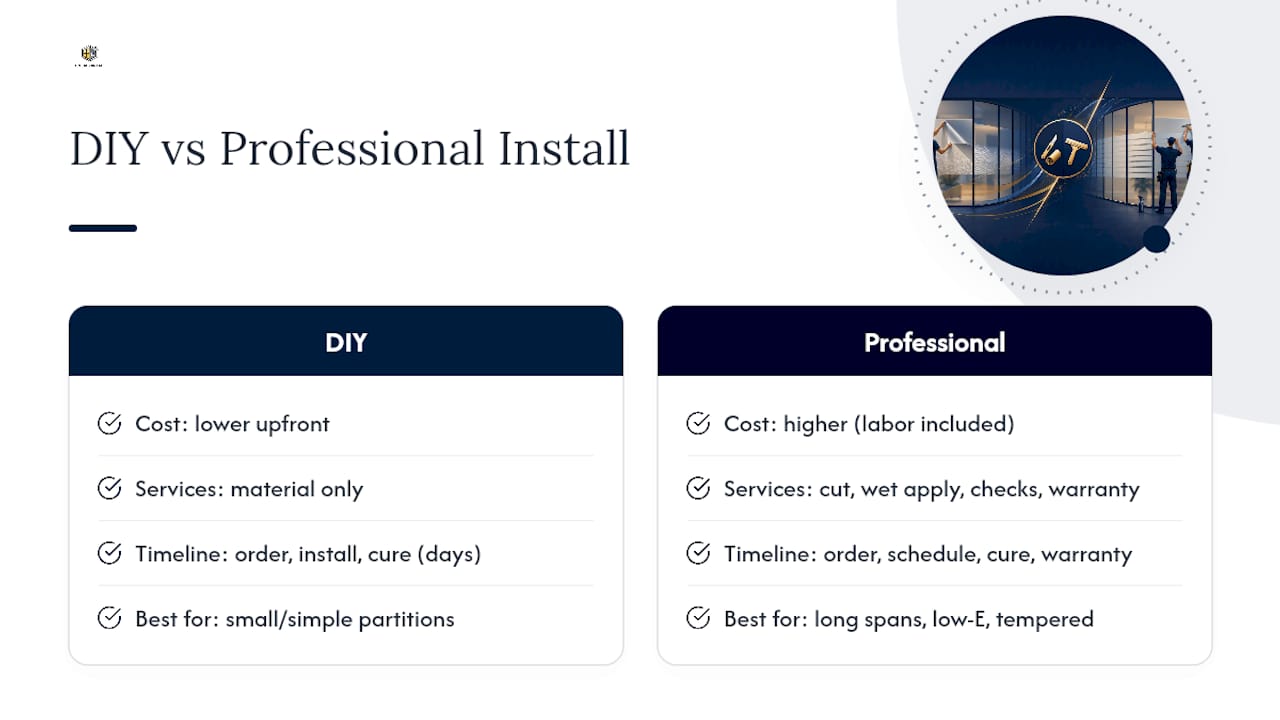
DIY rolls for frosted or decorative film typically run cheaper upfront since you’re only paying for material, not labor. Professional estimates factor in custom cutting, precise wet application, substrate checks, and a workmanship warranty, which is why the price gap exists.
Timeline-wise, expect this sequence: order or purchase the film, schedule or perform the install, then allow a cure period (often several days) before the adhesive fully clears and any temporary hazing disappears. Warranty activation, when applicable, typically follows that cure window.
Where professional installation earns its cost is on long glass spans, low-E or tempered glass, and any job where a warranty actually matters to you. Get it wrong on a large partition, and you’re looking at bubbling, peeling, or voided coverage. Tint Advantage’s own commercial window tint cost breakdown is a useful starting point if you’re budgeting a business install.
Statistic Callout: Professional-grade window film is commonly associated with significant heat reduction, and Tint Advantage clients report noticeable cooling cost drops after installation, a meaningful factor if your glass partition sits near an exterior wall or skylight.
What Are the Real Limitations of Privacy Film?
Cleaning matters more than people expect. Stick with mild detergent and a soft cloth on any film type, and skip ammonia-based cleaners on adhesive films since they can degrade the bond over time.
The biggest limitation buyers miss: reflective films reverse completely at night. Adhesive films can show temporary hazing during the cure window, which is normal, not a defect. And some films need specific manufacturer guidance for double-glazed or low-E glass, so check compatibility before you commit.
Pro Tip: Give adhesive film its full cure period, usually several days, before you scrub it down. Cleaning too early can lift edges or trap moisture under the surface.
Where Can You Buy Privacy Film, and What’s Your Next Step?
DIY rolls are widely available through big-box retailers and manufacturer sites in standard widths (48 inches is common), and products like Gila’s frosted privacy film come pre-cut for smaller panes. If you want a specific decorative pattern, order a sample or request a mock-up first. It’s a lot cheaper than discovering the pattern looks wrong once it’s already on the glass.
- Measure your glass pane precisely before ordering anything.
- Request a physical sample for any decorative or frosted product.
- If your partition is large, has specialty glazing, or you just want it done right the first time, schedule a free estimate with Omaha Window Tinting.
Why Decorative Film Wins Most Partition Projects
It’s the rare option that doesn’t force you to choose between privacy and daylight. Reflective film has its place for daytime-only storefronts or street-facing offices. Blackout earns its spot in media rooms or storage partitions. But for the conference room, the shared office wall, the bathroom door, frosted wins because it just works, every hour of the day, without any asterisks.
Get a Custom Privacy Film Install From Omaha Window Tinting
Buying a roll online is one path. Hiring a pro who measures, cuts, and installs it right the first time is another, and it’s the one that avoids bubbling, hazing complaints, and voided warranties down the line. Omaha Window Tinting handles custom measurement, professional wet application, and warranty-backed installs for both residential and commercial glass partitions.

If your partition involves low-E glass, an oversized pane, or you just don’t want to spend a Saturday fighting adhesive bubbles, that’s exactly when a professional install pays for itself. Tint Advantage’s crews install frosted, decorative, and reflective film with the same precision they bring to full-building solar control jobs, and clients report the privacy, daylight retention, and glare reduction hold up for years, not months. Request a free estimate from Omaha Window Tinting and get a same-week measurement on your partition. A sample swatch or in-person consultation is available before you commit to anything.
Sources
- A Complete Guide to Privacy Window Film - Concord Window Film
- Privacy film Lines Riga
- 3M™ Crystal Glass Finishes 7725SE-324, Frosted Crystal, 48 in x 150 ft, 1 Roll/Case | 3M United States
- BuyDecorativeFilm 48 in. x 100 ft. MTWH White Frosted Privacy Window Film