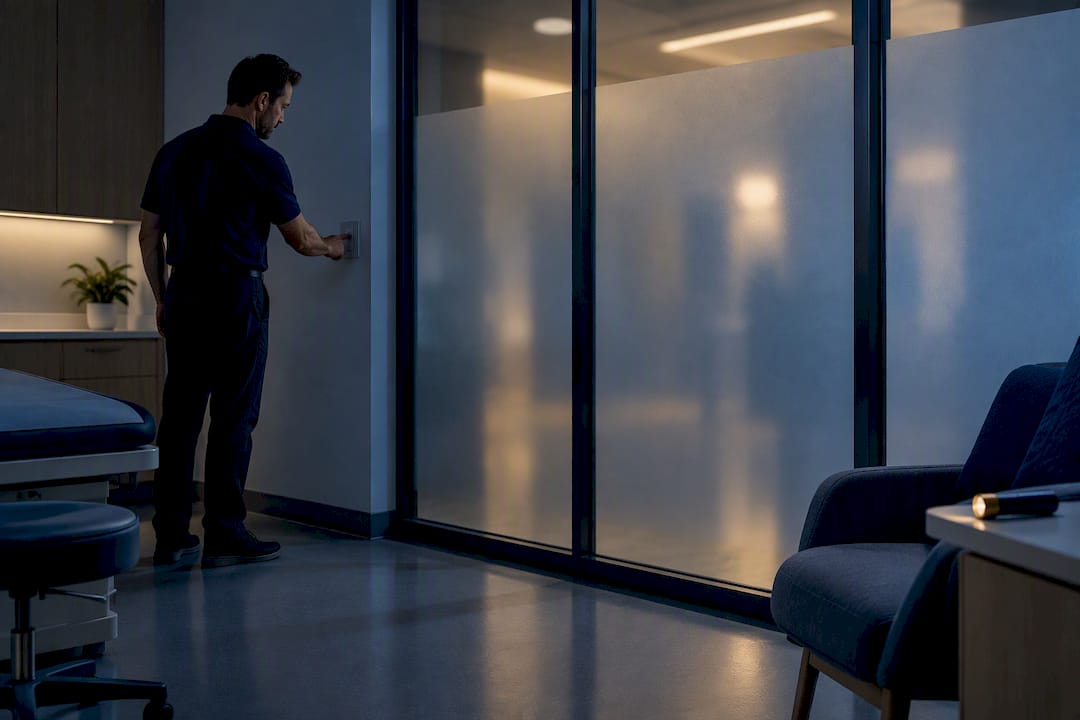
Facility Managers: Hospital Privacy Film Costs $8–$125, Night Tests
Yes, privacy window film works well in hospitals, and most facility teams should start their evaluation with three families: frosted or etched film for permanent privacy, one-way daylight film where staff need to see out without being seen, and switchable smart film for spaces that need privacy on demand. Each solves patient dignity differently. Security and infection-control compatibility are separate procurement checks, and we’ll walk through both below.
TL;DR:
- Frosted and etched films provide permanent privacy and are cost-effective for restrooms and fixed partitions, blocking sightlines day or night.
- One-way daylight films depend heavily on lighting conditions and should be supplemented with other privacy measures to ensure 24-hour confidentiality.
- Switchable smart film offers on-demand privacy control but requires electrical planning and costs significantly more per square foot.
- Combining privacy and security films is essential in high-risk areas like emergency rooms, but each layer must be specified and tested separately according to standards.
- Proper installation by manufacturer-certified professionals and thorough testing of visibility at different times are critical to avoid costly mistakes and complaints.
Table of Contents
- What Types of Privacy Window Film Work Best in Hospitals?
- Where Should Hospitals Install Privacy Film?
- Does Privacy Film Work the Same During the Day and at Night?
- Security Film vs. Privacy Film: Do You Need Both?
- How Does Privacy Film Compare to Curtains for Infection Control?
- What Should Be on Your Procurement Checklist?
- Why Professional Installation Matters for Hospital Film Projects
- What Facility Managers Get Wrong About Privacy Film
- Ready to Get Privacy Film Installed Right the First Time?
- Standards and Guidance Worth Reading
- Sources
- FAQ
What Types of Privacy Window Film Work Best in Hospitals?
Not every privacy film behaves the same way, and picking the wrong family for the wrong room is the most common mistake we see facility teams make.
Frosted and etched film delivers permanent obscuration. It’s the workhorse choice for restrooms, staff break rooms, and any glass partition that needs privacy around the clock. Frosted vinyl versions cost less and install faster than true etched glass looks, but both block sightlines equally well, day or night.
One-way and daylight films, sometimes called mirrored or reflective film, only work in one direction, and that direction depends on which side has more light. During the day, a patient room with bright hallway lighting and a dimmer interior can appear one-way from outside. Flip that lighting balance at night, and the effect reverses. We cover this tradeoff in more depth in our guide to one-way window film, but the short version: never rely on daylight film as your only privacy layer in a 24-hour care environment.
Switchable PDLC smart film turns opaque with the flip of a switch, using an electrical current to scatter light through the film’s liquid crystal layer. It’s the most flexible option for exam rooms, consult spaces, and behavioral health units where privacy needs change throughout the day. It also costs more, generally substantially higher per square foot installed compared to standard frosted or privacy film.
- Frosted/etched: permanent, affordable, ideal for restrooms and fixed partitions
- One-way/daylight: conditional privacy, best as a supplement, not a standalone solution
- Switchable PDLC: on-demand control, higher cost, requires electrical planning
- Decorative branding film: adds wayfinding or identity while providing partial screening in lobbies and corridors
Where Should Hospitals Install Privacy Film?
Placement decisions come down to one question: does this glass need continuous dignity protection, or does staff observation take priority?
- Patient rooms and exam rooms. Frosted vinyl on lower glass panels, paired with switchable film on interior sidelights, gives patients control without blocking staff access entirely.
- ICU bays and ER observation glass. This is where you can’t sacrifice sightlines. Many facilities use switchable film here so nurses retain full visibility during rounds and can activate privacy only during exams or family visits.
- Nurse stations and glass partitions. Partial-height frosted bands protect confidential conversations at the desk while keeping the station open and approachable above eye level.
- Public areas, reception, and staff lounges. Decorative or lightly frosted film manages glare and softens sightlines without the full-privacy treatment patient rooms need.
- Code-restricted glazing. Fire-rated glass, egress windows, and certain corridor sidelights may have transparency requirements that limit how dark or opaque a film can go. Always confirm with your facilities engineer before specifying.
Does Privacy Film Work the Same During the Day and at Night?
No, and this is the single biggest source of complaints after installation. One-way effects depend entirely on the light ratio between the two sides of the glass. During the day, exterior light usually overwhelms interior light, so film that looks reflective from outside lets people inside see out clearly. At night, interior lighting typically dominates, and that relationship flips: the room that felt private during daylight hours can become visible from outside once the lights come on and the sky goes dark.
Before signing off on any privacy film contract, request the manufacturer’s test data on visible light transmission (VLT), reflectance percentage, and UV block rate. These numbers tell you how the film actually performs, not just how the sales brochure describes it.
- Ask for a daytime and nighttime mock-up in the actual room, not a showroom sample
- Walk the corridor at night with interior lights on to check real sightlines
- Test with blinds or curtains fully open to confirm worst-case visibility
- Use switchable film in rooms where lighting conditions can’t be controlled
A quick reality check: switchable PDLC film is the only privacy family in this list designed to maintain consistent performance both day and night by not relying on ambient light contrast. That’s exactly why it costs more.
Security Film vs. Privacy Film: Do You Need Both?
Privacy film and security film solve different problems, and confusing them leads to expensive gaps in protection. Privacy film obscures the view through glass. Security film, usually a thicker laminated product, holds shattered glass together to slow forced entry, reduce injury from flying shards, and buy time during an active threat event.
Emergency departments, behavioral health units, and ground-floor exterior glazing frequently need both properties layered into one system. CISA’s protective measures guidance for healthcare facilities treats window film as one piece of a broader, risk-assessed security plan rather than a standalone fix, and that framing matters when you’re deciding how far to invest.
- Specify glass retention and forced-entry performance separately from VLT and privacy ratings
- Reference GSA’s standard test method for security glazing when writing procurement specs
- Confirm the warranty covers both the security laminate and any decorative or privacy layer applied on top
- Ask whether combined systems require different cleaning protocols than standard privacy film
How Does Privacy Film Compare to Curtains for Infection Control?
Fabric curtains get touched constantly. Every clinician who pulls one shut for an exam is adding hand contact to a surface that’s hard to disinfect thoroughly and often gets replaced on a fixed laundry schedule rather than after every use. Window film is a flat, wipeable surface, closer in behavior to the glass and wall surfaces already built into your standard cleaning protocol.
That said, not every disinfectant is safe for every film. Standard frosted and vinyl films generally tolerate hospital-grade cleaners fine. PDLC smart film is more sensitive. Abrasive pads and some high-alcohol solutions can degrade the surface layer over time and void the warranty.
- Confirm disinfectant compatibility in writing before installation, not after a complaint
- Inspect film edges and seams quarterly for lifting or peeling in high-traffic rooms
- Budget for replacement on a longer cycle than curtains, typically several years rather than months
Pro Tip: Ask your installer for a written list of approved cleaning products and keep it in your infection prevention binder. When a warranty claim comes up years later, that document is what protects you.
What Should Be on Your Procurement Checklist?
A rushed spec is how facilities end up with film that looks fine in the sample book and fails the first night shift. Work through this list before signing anything.
- Define your privacy target per room type. ICU bays, exam rooms, and public corridors don’t need the same VLT or reflectance numbers.
- Set UV block and disinfectant compatibility requirements in writing, especially if the space also handles medication storage or has furnishings that fade in sunlight.
- Identify rooms needing security performance, and request GSA-referenced test data for any laminated security layer.
- Confirm electrical and control requirements for smart film, including low-voltage wiring runs and where switches or sensors will live.
- Ask vendors about manufacturer-authorized installer certification, warranty length, and whether they offer a pilot installation in one room before a full rollout.
- Schedule acceptance testing at handover, including a nighttime sightline check, before final sign-off.
| Budget factor | What drives the cost |
|---|---|
| Standard privacy film | $8 to $15 per square foot installed |
| Security and safety film | $12 to $25 per square foot installed |
| Switchable smart film | $85 to $125 per square foot installed |
| Added cost drivers | Electrical work, control wiring, specialty or curved glass, total square footage |
Retrofit installations for standard privacy film typically move fast, often a day or two per unit depending on room count. Smart film retrofits generally run one to two weeks depending on project scale, since electrical integration adds coordination time that simple adhesive film doesn’t require.
Why Professional Installation Matters for Hospital Film Projects
A poorly installed privacy film shows every bubble and seam under fluorescent corridor lighting, and in a hospital, that’s a visible signal of neglect to patients and visitors alike. Manufacturer-authorized installation, backed by a documented warranty, is what protects a facility from having to redo a wing’s worth of glass two years in.
A typical project moves through a site survey, a sample or pilot installation in one representative room, full installation, and a punchlist walkthrough before final acceptance. Commercial-grade films from manufacturers like 3M also carry documented energy performance claims, which matters when a facilities director is building the case for solar control film alongside privacy upgrades, as covered in our low-e window film guide.
- Request references from other healthcare or medical office installations
- Ask for the installer’s certification status with the film manufacturer
- Confirm punchlist items get resolved before the final invoice is paid
Daylight exposure in patient care areas correlates with improved comfort and, in some studies, better outcomes, which is exactly why preserving natural light while adding privacy is worth the extra planning effort.
What Facility Managers Get Wrong About Privacy Film
The mistake I see most often is a facility team approving a film based on a daytime showroom demo and never checking it after dark. That single oversight causes more complaint calls than any other part of this process.
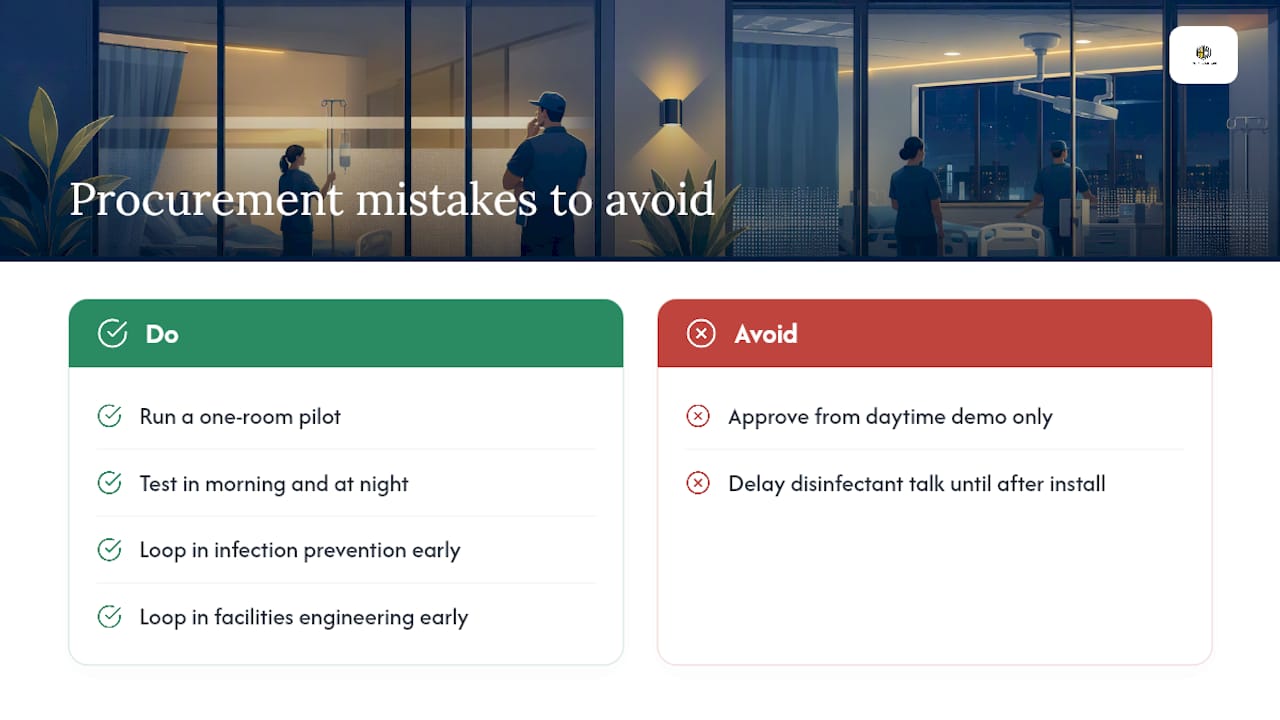
The second mistake is skipping the disinfectant conversation until after installation, then discovering the cleaning crew’s usual product isn’t approved for the new film.
If you only do one thing before your next procurement meeting, run a small pilot in one room, test it morning and night, and loop in infection prevention and facilities engineering early rather than after the purchase order is signed. That single step catches most of the problems this article covers.
— Ron
Ready to Get Privacy Film Installed Right the First Time?
Curtains and blinds solve part of the privacy problem, but they add laundry costs, touchpoints, and maintenance headaches that hospitals are trying to reduce, not add. Professional installers provide privacy, security, and switchable smart film with manufacturer-backed warranties and precise, seam-free craftsmanship that holds up under the lighting scrutiny of a hospital corridor.

We handle the site survey, walk you through sample options for your specific rooms, and can set up a pilot installation before you commit to a full wing. Whether you’re looking at commercial window tinting for patient rooms or reviewing current pricing on privacy and smart film, the next step is simple: request a site-survey call and get a real quote for your facility’s glass.
Standards and Guidance Worth Reading
Before finalizing a spec, review CISA’s healthcare protective measures guide, HHS’s HIPAA privacy guidance, and GSA’s security glazing test methods.
Sources
FAQ
Is There a Window Film I Can See Out of but People Can’t See In?
One-way and daylight films create this effect, but only under the right lighting conditions, typically when the outside is brighter than the inside. At night, that effect reverses, so most hospitals pair one-way film with switchable smart film in rooms where privacy has to hold up around the clock.
Can You See Through Privacy Window Film at Night?
Standard frosted and etched film stays opaque regardless of lighting, so no. One-way and daylight films behave differently. Once interior light exceeds exterior light after dark, visibility can shift toward the inside becoming visible from outside, which is why nighttime mock-up testing matters before installation.
What Are the Disadvantages of Window Privacy Film?
The main tradeoffs are cost for premium options like switchable film, the day/night visibility shift in one-way films, and the need to verify disinfectant compatibility before installation. A properly specified system, tested in the room under real lighting conditions, avoids most of these issues.
Can You Legally Install Privacy Film in a Hospital?
Yes, film installation is a facilities decision, not a legal restriction, though HIPAA guidance from HHS requires facilities to consider patient confidentiality and sightlines when modifying glazing. Code requirements for fire-rated or egress glass may limit how opaque a film can be in specific locations, so confirm those details with your facilities engineer first.
How Much Does Hospital Privacy Window Film Cost to Install?
Standard privacy film typically runs $8 to $15 per square foot installed, while switchable smart film runs $85 to $125 per square foot due to the electrical components involved. Tintadvantage lists current installed pricing for residential and commercial privacy film for facilities requesting a detailed quote.