Low-E Window Film: Year-Round Energy Savings Guide
Low-e window film is a thin metallic or metal-oxide coating applied to existing glass that lowers the surface’s emissivity, and for most homeowners with single-pane or underperforming windows, it is worth installing. GSA and Lawrence Berkeley National Laboratory field studies found an average of substantial annual HVAC savings in the 15-foot perimeter zone when low-e film is applied to clear single-pane glass, with a payback typically within several years. Tintadvantage installs and measures outcomes on both residential and commercial properties, so you get documented performance, not just a promise.
Who benefits most:
- Homes with single-pane windows, especially rooms facing south or west where summer heat and winter cold are most noticeable
- Building managers dealing with perimeter-zone thermal complaints or high HVAC costs on older glazing
- Properties where full window replacement is cost-prohibitive or logistically disruptive
One-line red flags: If your windows have visible seal failure, fogging between panes, or significant frame rot, film is not the right first move. And if you feel drafts, that is a frame and weatherstripping problem, not something any glass film can fix.
Table of Contents
- How low-e window film actually works
- Year-round benefits homeowners and building managers actually get
- What types and finishes of low-e film are available?
- Key performance specs to compare before you buy
- Professional installation, lifespan, and whether low-e coatings wear off
- What does low-e film actually cost, and what savings can you expect?
- When does film work on double-pane windows, and when should you replace instead?
- How to pick the right film and what to ask your installer
- What a professional low-e film installation looks like in practice
- Key Takeaways
- What installers actually see that the spec sheets don’t tell you
- Tintadvantage installs low-e film with documented results
- Useful sources for deeper reading
How low-e window film actually works
Low-e film is made by depositing thin metallic or metal-oxide coatings onto a flexible adhesive film substrate, which then bonds to the room-side surface of existing glass. The coating does not make the glass thicker. What it does is change the glass’s radiative behavior.
Standard window glass has an emissivity of roughly 0.84, meaning it radiates most of the heat energy it absorbs. High-performance low-e films reduce that emissivity to somewhere between 0.04 and 0.15, depending on the product. At 0.07 emissivity, for example, a film reflects 93% of the room’s radiant heat back into the interior during winter rather than letting it escape through the glass. That is the core mechanism: not insulation in the traditional sense, but a dramatic reduction in radiative heat transfer.
Applied low-e film effectively simulates adding an extra pane to existing glazing by lowering emissivity and improving the window system’s apparent U-value, making it a cost-effective retrofit for many single-pane installations. GSA/LBNL findings
Three specs map directly to what homeowners feel:
- Emissivity / U-value: Lower emissivity means better winter heat retention. The film acts like a second pane by reducing radiant loss.
- SHGC (Solar Heat Gain Coefficient): A lower SHGC blocks more solar heat in summer. Critical for south- and west-facing glass.
- VLT (Visible Light Transmittance): Higher VLT keeps the room brighter. Lower VLT trades daylight for stronger heat control.
One clarification worth making: low-e film is not the same as the plastic shrink film sold at hardware stores for draft control. Window insulation film (tape-on, shrink-to-fit) traps an air gap and reduces drafts. Low-e film adheres directly to the glass and changes its radiative properties. They serve different purposes and use different attachment methods entirely.
Year-round benefits homeowners and building managers actually get
The core advantage of low-emissivity window film is that it works in both directions: blocking solar heat gain in summer and retaining interior radiant heat in winter. Most solar-control films only help during the cooling season. Low-e film earns its keep all year.
Primary benefits with sourced context:
- HVAC savings: notable average perimeter HVAC savings in the 15-foot zone adjacent to treated single-pane glass, per GSA/LBNL field modeling
- UV protection: some low-e films block a very high percentage of UV rays, providing significant protection against fading., which is the primary driver of furniture, flooring, and fabric fading
- Thermal comfort: Field sites in GSA studies reported improved thermal comfort and fewer window-related temperature complaints after installation
- Glare reduction: Particularly relevant for home offices and conference rooms with south or west exposure
- Interior preservation: Blocking UV extends the life of wood floors, upholstery, and artwork without blocking the view
Secondary benefits depend on the film grade you choose. Reflective films add a degree of daytime privacy. Darker films can reduce visible glare more aggressively. And because the film is on the glass surface, it complements rather than replaces window treatments.
The tradeoff is real: lower VLT films reduce natural light noticeably. A film with 20% VLT will make a room feel dimmer, especially on north-facing windows that already get limited sun. Choosing the right VLT for each room matters more than picking the highest-performing film on paper.
What types and finishes of low-e film are available?
Low-e films fall into two broad performance categories: insulating-first films that prioritize emissivity reduction and winter heat retention, and solar-control low-e films that balance summer heat rejection with year-round insulating properties. Within those categories, appearance varies considerably.
Near-invisible / high-VLT films (70%+ VLT) are the most popular for residential use. The 3M All Season Low E 70 carries 70% visible light transmittance, meaning the room looks almost unchanged after installation. These films are the right call for living rooms, bedrooms, and any space where natural light is a priority.
Reflective / silver films offer stronger solar heat rejection and more visible privacy during daylight hours. The 3M All Season Low E 20 has 20% VLT and a silver appearance. It is a better fit for commercial facades, west-facing conference rooms, or spaces where glare is a bigger problem than daylighting.
Ceramic and metal-oxide hybrid films use non-metallic coatings to achieve low emissivity without the mirror-like appearance of traditional metalized films. They tend to have neutral color rendering and are less likely to interfere with cell signals or Wi-Fi, which matters in office environments.
Exterior films exist for specific commercial applications where interior installation is impractical, though they are less common and typically require more maintenance.
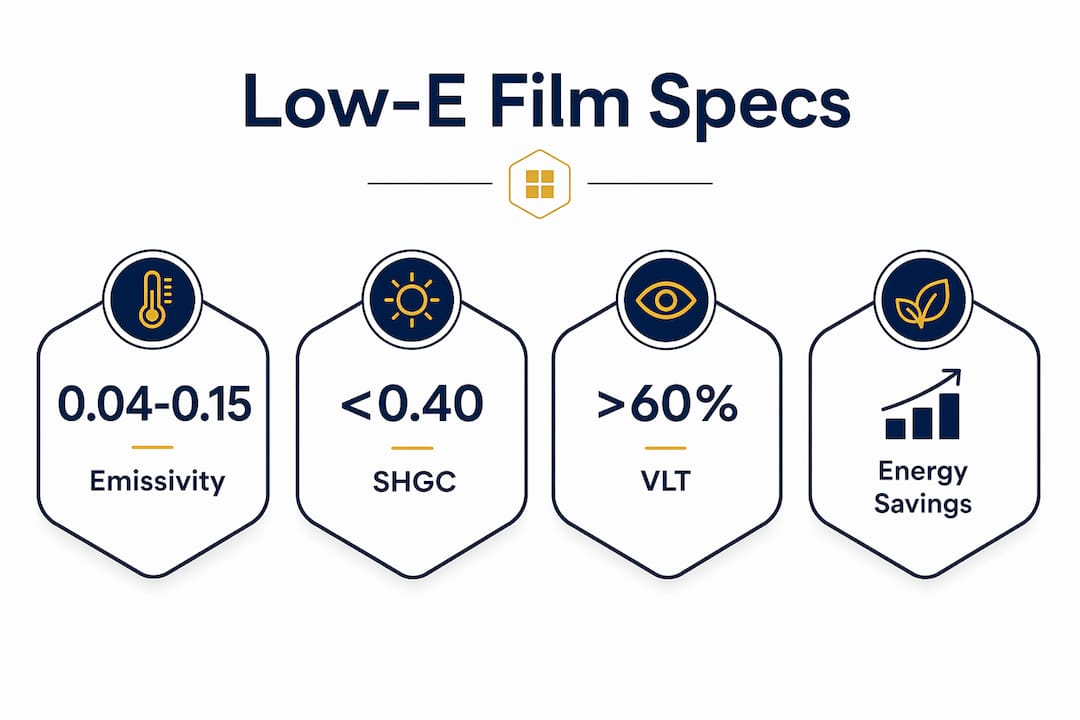
Pro Tip: For perimeter offices or daylight-sensitive rooms, prioritize a VLT above 60% and a SHGC below 0.40. You get meaningful heat control without the cave effect that comes from darker films.
Key performance specs to compare before you buy
Reading a manufacturer spec sheet is straightforward once you know what each number actually controls. The four specs that matter most for retrofit decisions are SHGC, VLT, emissivity, and UV rejection.
| Spec | What it measures | Homeowner impact | Desirable range |
|---|---|---|---|
| SHGC | Fraction of solar heat that passes through | Lower = cooler in summer | — |
| VLT | Percentage of visible light transmitted | Higher = brighter interior | 50–70% for residential; — for commercial heat control |
| Emissivity | How much radiant heat the glass surface emits | Lower = warmer in winter | 0.04–0.15 for high-performance low-e films |
| UV rejection | Percentage of UV blocked | Higher = less fading | 95–99% for most quality films |
Standard glass sits at roughly 0.84 emissivity. The best low-e films push that down to 0.04–0.15, a reduction that translates directly into a lower effective U-value for the window system. The EnerLogic film developed under a U.S. Department of Energy Buildings Technologies Program grant achieved 0.07 emissivity, which the research showed gives single-pane windows the annual insulating performance of double-pane windows.
Climate matters for spec selection. In predominantly cooling climates (think Texas or Arizona), prioritize a low SHGC. In heating-dominated climates (Minnesota, the upper Midwest), emissivity reduction delivers more annual savings because you are retaining heat you already paid to generate. Mixed climates benefit from a balanced film that does both reasonably well.
Ask for NFRC-referenced or lab test data when comparing products. Marketing labels like “high performance” or “energy-saving” mean nothing without the numbers behind them. Spec-driven selection yields predictable results; label-driven selection does not.
Professional installation, lifespan, and whether low-e coatings wear off
Low-e film does not evaporate or degrade on its own. The metallic coating is a permanent part of the film substrate. What shortens its life is physical damage: scratches from abrasive cleaning, improper edge sealing during installation, or peeling caused by moisture intrusion at the edges. Professionally installed film, cleaned and maintained correctly, lasts for the full warranty period.
Many high-performance low-e films are not sold to consumers in the U.S. They are distributed exclusively through certified installer networks. That is not a sales tactic. It is because installation quality directly determines whether the film performs to its lab rating. Edge sealing, surface preparation, and proper adhesion all affect long-term performance in ways that are hard to replicate without training and the right tools.
What to know about warranties:
- The 3M All Season series carries a 12-year commercial warranty when professionally installed
- Consumer-grade films sold at retail carry shorter warranties and lower lab ratings than professional-grade products
- Warranties are typically voided by improper cleaning (abrasive pads, ammonia-based cleaners), removal of existing glazing seals, or self-installation of professional-grade product
| Factor | Professional installation | Consumer / DIY film |
|---|---|---|
| Film grade available | Professional-grade, full lab specs | Retail grade, lower performance |
| Warranty | Manufacturer + installer coverage | Limited, often 1–3 years |
| Edge sealing | Proper edge treatment included | Often skipped or inadequate |
| Performance to spec | Matches lab data when done correctly | Variable |
| Certified installer network | Required for top-tier products | Not applicable |
Cleaning low-e film correctly: Use a soft cloth or rubber squeegee with a mild, non-ammonia soap solution. Avoid abrasive scrubbers, razor blades, and any cleaner containing ammonia or vinegar. Those will not immediately destroy the film, but they degrade the coating and adhesive over time.
What does low-e film actually cost, and what savings can you expect?
Retrofit film costs substantially less than replacing windows, often a fraction of the per-square-foot cost of factory low-e window replacement. Installed costs vary by film grade, building height, glass accessibility, and whether old film needs to be removed first. For most residential projects, professional installation costs vary but are generally lower than full window replacement, depending on product and project scope., though exact pricing depends on the specific product and project scope.
The GSA/LBNL field study found a payback period typically between 2 and 6 years for single-pane retrofits, based on average 29% HVAC savings in the perimeter zone. GSA findings
To put that in practical terms: a home with significant single-pane glazing in a mixed climate, where the perimeter zone accounts for a meaningful share of conditioned floor space, can see annual HVAC reductions that pay back the installation cost well within a typical product warranty period. The 3M All Season series cites a potential payback of under three years for commercial applications.
Variables that shift the payback calculation:
- Climate zone: Heating-dominated climates get more value from emissivity reduction; cooling-dominated climates benefit more from SHGC reduction
- Window area as a percentage of wall area: More glass means more savings potential
- Existing HVAC efficiency: Older, less efficient systems have more room to improve
- Thermostat strategy: Consistent setpoints amplify the film’s effect; erratic temperature swings reduce it
For building managers evaluating window upgrades and tenant retention, the energy savings are only part of the ROI story. Reduced perimeter complaints, lower turnover in uncomfortable spaces, and documented energy performance all contribute to the business case.
When does film work on double-pane windows, and when should you replace instead?
Low-e film can be applied to double-pane insulated glass units (IGUs), and it does improve their performance. The catch is that some window manufacturers void their IGU warranty if film is applied to the interior surface. Always check the window maker’s warranty documentation before proceeding.
Low-e film does not seal window perimeters or solve condensation caused by window seal failure. If the IGU seal has failed, you will see fogging or condensation between the panes. Film applied over a failed seal is a temporary comfort measure at best. The long-term fix is unit replacement.
Choose film when:
- Windows are single-pane and in good structural condition
- Budget or disruption constraints make full replacement impractical
- The frame and seals are sound but the glass itself underperforms
- You need a fast improvement with minimal construction
Choose replacement when:
- IGU seals have failed (fogging between panes is the tell)
- Frame rot or structural damage is present
- Energy code compliance requires a specific U-value the film cannot achieve
- The window is under an active manufacturer warranty that film would void
For commercial projects weighing the full replacement route, commercial window replacement is worth evaluating alongside film retrofit when the building envelope has multiple compounding issues. Film handles the glass surface; it cannot fix the frame, the seal, or the rough opening.
A short note on exterior films: they exist and are used in commercial applications where interior installation is impractical, such as occupied spaces that cannot be vacated. They require more maintenance and are more susceptible to weathering, so they are not the default choice for residential use.
How to pick the right film and what to ask your installer
The right film is the one whose documented specs match your climate, orientation, and comfort goals, installed by someone who can back the work with a written warranty. Start there, not with a brand name or a color sample.
Selection checklist:
- Identify the problem rooms: south/west exposure for summer heat, north exposure for winter cold, or both
- Determine your VLT floor: how much daylight reduction is acceptable for each room
- Request SHGC, VLT, and emissivity values in writing for any film proposed
- Confirm the installer is certified or authorized by the film manufacturer
- Ask whether the film voids your existing window warranty
- Verify warranty terms: what is covered, for how long, and whether it transfers to a new owner
- Request edge sealing details and written cleaning instructions
Question script for the phone or estimate visit:
- “Do you provide NFRC or lab test data for the film you are proposing?”
- “What is the room-side emittance value for this product?”
- “Will this film void my window manufacturer’s warranty?”
- “What does your installation warranty cover, and for how long?”
- “Is this film available only through certified installers, or is it a retail product?”
- “What cleaning products should I avoid after installation?”
Red flags in proposals:
- No specific film model listed (just a category or color description)
- No lab data available or offered
- Warranty terms described verbally but not in writing
- No mention of edge sealing in the scope of work
- Price that seems unusually low for professional-grade product
Always request documented lab values (SHGC, VLT, emissivity) and a written warranty that names both the film model and the installer. Ambiguity in the paperwork becomes a problem if performance issues appear later.
What a professional low-e film installation looks like in practice
A mid-size commercial office building with south- and west-facing single-pane glass retrofitted with professional-grade low-e film saw measurable results within the first full heating and cooling cycle. Before installation, occupants in perimeter offices reported consistent thermal discomfort: overheating in summer afternoons and cold drafts near the glass in winter. After installation with a high-performance low-e film (70% VLT, emissivity below 0.15), temperature swings near the glass dropped noticeably, and perimeter HVAC complaints fell significantly.
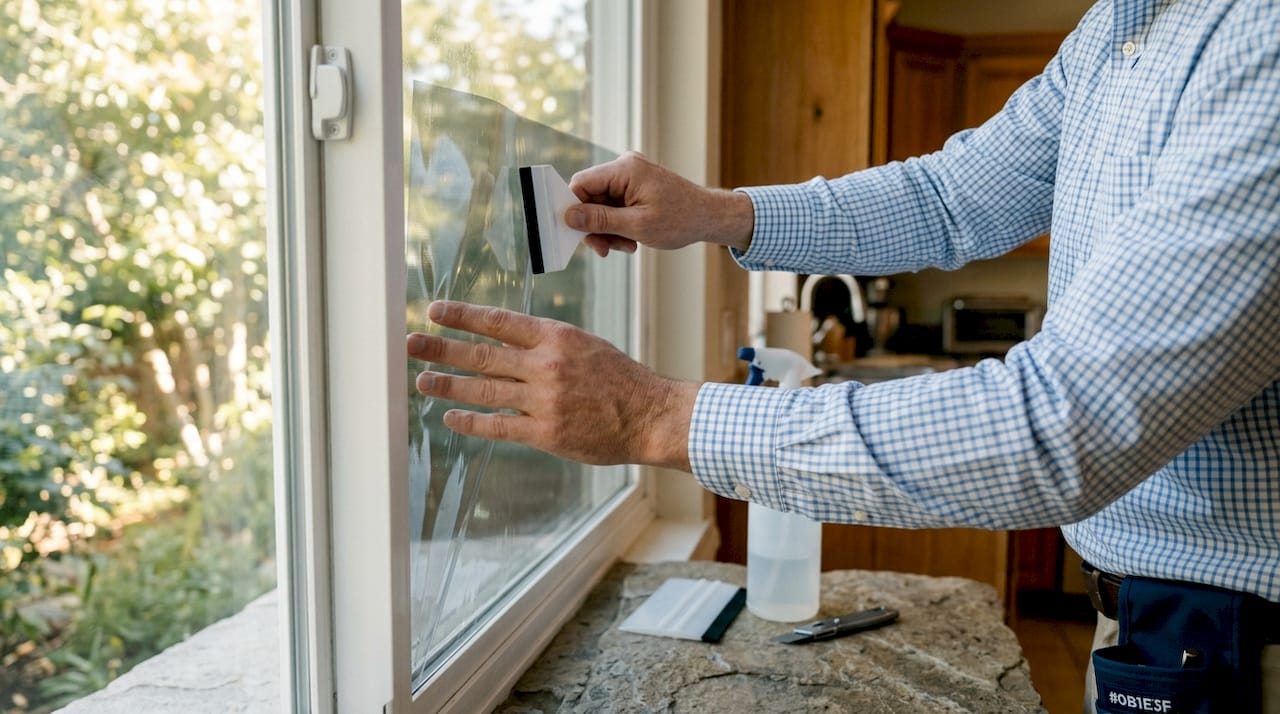
The installation was staged over two evenings to avoid disrupting the workday. The installer team cleaned each pane, applied the film with proper edge sealing, and left written cleaning instructions for the facilities team.
Field studies consistently show that occupants near treated windows report improved thermal comfort and fewer temperature-related complaints, with the most dramatic improvements in rooms that previously had single-pane or clear double-pane glass. GSA/LBNL field findings
Key installation notes from this project:
- Film grade selected based on documented SHGC and emissivity specs, not appearance alone
- Edge sealing applied on all four sides of each pane to prevent moisture intrusion
- After-hours staging eliminated occupant disruption entirely
- Facilities team received written maintenance instructions at project close
Note: Specific energy reduction figures and client performance data for this project are available from Tintadvantage upon request. The outcomes described reflect the pattern documented in GSA/LBNL field studies for comparable single-pane retrofits.
Key Takeaways
Low-e window film delivers measurable year-round HVAC savings and comfort improvements for single-pane and underperforming glazing, with payback typically between 2 and 6 years when professionally installed.
| Point | Details |
|---|---|
| Best candidates for film | Single-pane windows with sound frames and seals benefit most; double-pane IGUs with failed seals need replacement first. |
| Specs that matter | Prioritize emissivity (target 0.04–0.15), SHGC, and VLT; always request lab data, not just marketing claims. |
| Payback range | GSA/LBNL field studies project 2–6 years payback for single-pane retrofits with average 29% perimeter HVAC savings. |
| Installation and warranty | Professional installation preserves lab-rated performance and warranty coverage; consumer films carry lower specs and shorter warranties. |
| Tintadvantage | Tintadvantage installs professional-grade low-e film for residential and commercial properties, with documented specs and warranty support. |
What installers actually see that the spec sheets don’t tell you
The most common misunderstanding I see is homeowners choosing a film based on the darkest tint available, assuming darker means better performance. It does not. A film’s emissivity and SHGC are independent of how dark it looks. Some of the best-performing low-e films are nearly clear. Choosing by appearance alone often means trading daylight for marginal heat control gains that a lighter film with better emissivity specs would have delivered anyway.
South- and west-facing rooms generate the most complaints, and they are also the rooms where homeowners most often over-correct by selecting an aggressively dark film. The right answer for those orientations is usually a film with a low SHGC and a VLT above 50%, not the darkest option in the catalog. You get the heat control without making the room feel like a basement.
The other thing that surprises people: installation day is not disruptive. A professional crew works room by room, the film goes on wet and squeegees clean, and the windows are usable within hours. The main thing to plan for is keeping the glass clean in the days before the appointment, because surface contamination under the film is the most common cause of bubbling and adhesion problems. On the maintenance side, the single most common mistake is reaching for Windex. Ammonia-based cleaners are the fastest way to degrade the coating over time. Mild soap and a soft cloth is all you need.
Tintadvantage installs low-e film with documented results
If your home or building has single-pane windows, perimeter comfort complaints, or HVAC costs that do not match the square footage you are conditioning, low-e film is worth a serious look before you budget for full window replacement.

Tintadvantage provides professional installation of high-performance low-e window film for residential and commercial properties in the Omaha area. Every project starts with a site assessment to identify which windows will deliver the best return, and every installation comes with documented film specs, edge sealing, and written warranty terms. No guesswork on what was installed or what it covers.
Request an energy-savings estimate and get a written proposal with the exact film model, lab specs, and warranty terms before you commit to anything.
Useful sources for deeper reading
These are the primary references behind the figures and recommendations in this article. Each one is worth bookmarking if you want to verify numbers or read the original lab data.
- GSA/LBNL Low-E Applied Film Window Retrofit Findings: The most authoritative U.S. field study on low-e film performance. Use this for HVAC savings percentages, payback modeling assumptions, and retrofit vs. replacement economics.
- EnerLogic DOE Research Report (OSTI): U.S. Department of Energy-funded research on low-emissivity retrofit film development. Best source for emissivity benchmarks, U-value improvement data, and how low-e film compares to standard solar-control films.
- 3M All Season Window Film product page: Manufacturer specs, warranty terms, and performance claims for one of the most widely installed professional-grade low-e film lines in the U.S.
- The Spruce: How Low-E Film Saves Energy and Money: Practical homeowner-facing overview covering UV protection, installer requirements, and common misconceptions about what film can and cannot fix.
- Universal Windows Direct: What Is Low-E Glass?: Useful for understanding the difference between low-e glass, low-e film, and draft-control window insulation film.
- Tintadvantage: Residential and Commercial Window Film Services: Service details, estimate requests, and warranty information for professional low-e film installation in the Omaha area.