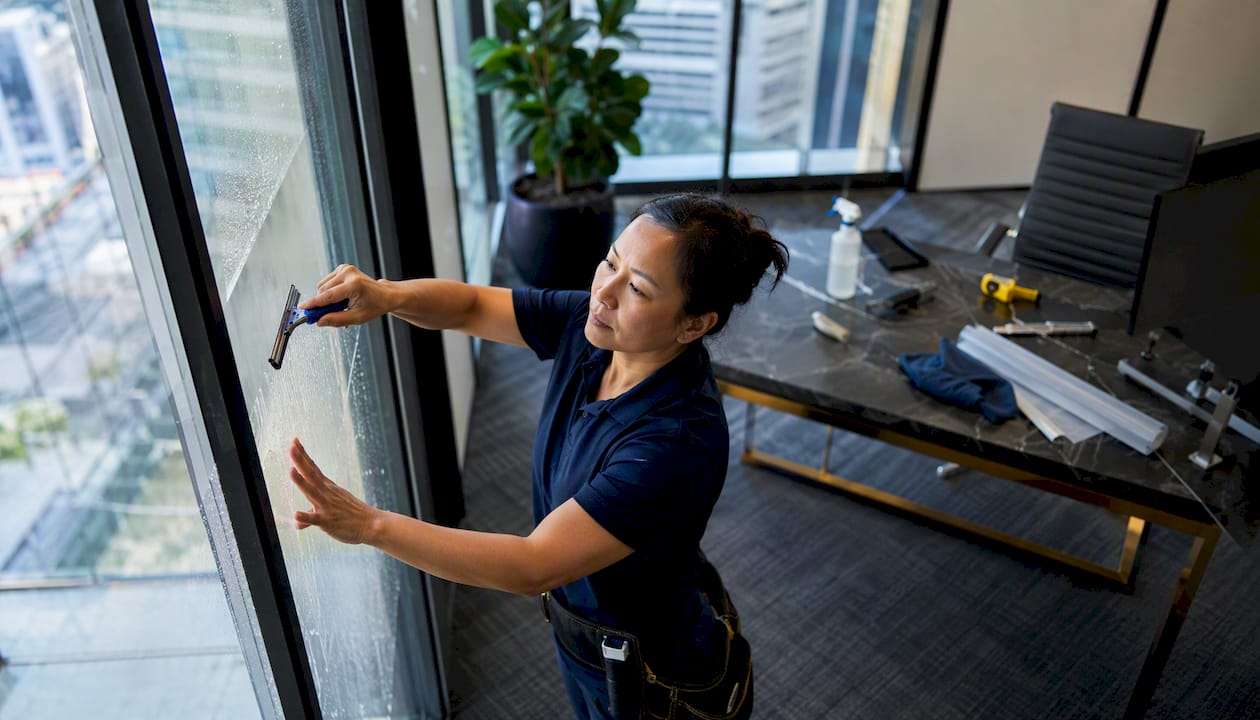
Office Privacy Window Film: Balance Light and Confidentiality
For most offices, the right call is a professionally installed frosted or ceramic privacy film. It keeps natural light flowing while blocking sightlines into conference rooms, private offices, and reception areas. Tintadvantage reports that high-performance films can reduce heat gain by up to 80%, and clients regularly report cooling cost reductions of 10–20% after installation. The fastest next step is to contact Tintadvantage for a free site survey and sample application before you commit to any product.
Table of Contents
- What types of office privacy window film work best?
- How well do privacy films actually perform — and where do they fall short?
- DIY peel-and-stick film or professional installation — which one is right for you?
- How do you choose the right privacy film for your office?
- Why professional installation delivers better results
- Key Takeaways
- The case for getting a site survey before you buy anything
- Tintadvantage installs privacy film that actually lasts
- Useful sources and further reading
What types of office privacy window film work best?
Not every film suits every space, and the differences matter more than most buyers expect.
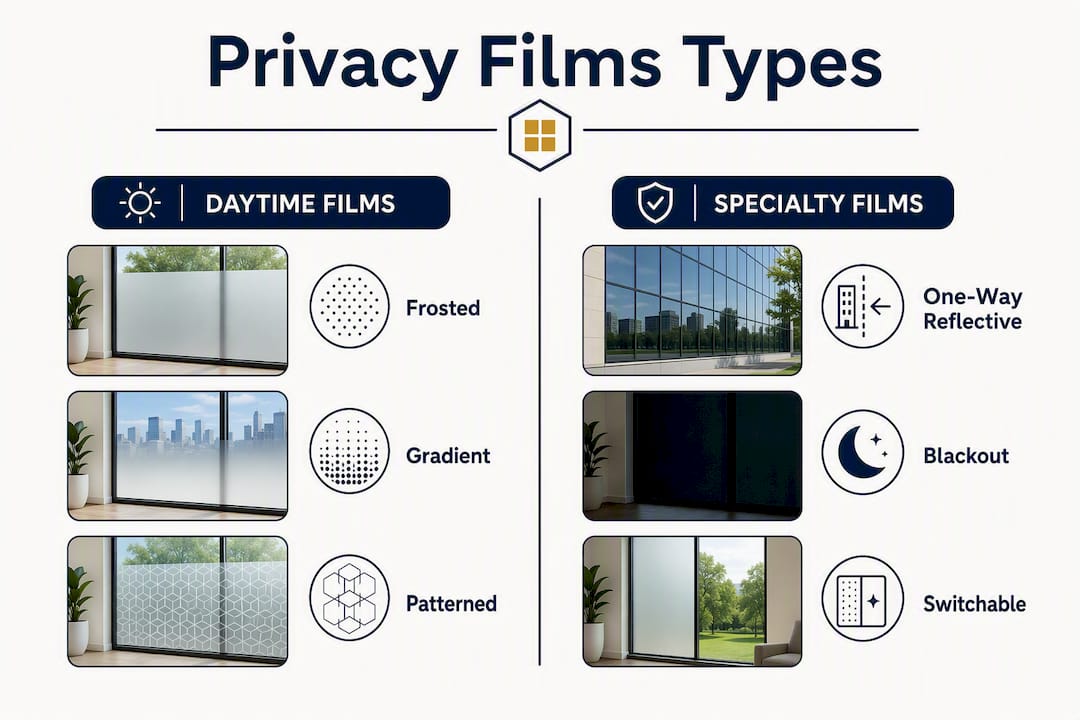
Frosted and etched films are the workhorses of office privacy. They scatter light rather than block it, so a frosted window film on a conference room door still lets daylight pass while keeping the meeting inside. Visible light transmission (VLT) on frosted films varies depending on density, allowing customization of the amount of light retained.
Gradient films fade from opaque at the bottom to clear at the top, which is exactly right for reception desks or low-partition glass where you want eye-level privacy without cutting off the view of the ceiling. Gradient and patterned films are a popular choice for conference rooms and partial privacy zones because they preserve the open-office feel while managing sightlines.
Patterned and dot films use geometric or repeating designs to obscure vision at a distance while still admitting light. They double as branding surfaces when cut into custom shapes or logos.
One-way/reflective films work on exterior-facing glass where outside light is brighter than the interior. During the day, the exterior sees a mirror; from inside, you see out. At night, that equation flips.

Blackout films block all light and are best reserved for server rooms, storage areas, or any space where total visual and light control matters more than daylight.
Switchable (smart) films go from opaque to clear on demand via a switch or app. The cost is significantly higher than static films, but for a boardroom that doubles as a presentation space, the flexibility is hard to match.
Ceramic and solar control films add privacy through tinting while delivering the strongest heat and UV rejection. They are the right choice when glare and overheating are as much of a problem as sightlines.
Pro Tip: Match film type to the room’s function. Frosted or gradient film for conference rooms and private offices; one-way reflective for street-facing storefront glass; switchable film for executive boardrooms; ceramic tint for south- or west-facing walls that overheat in summer.
How well do privacy films actually perform — and where do they fall short?
The short answer: excellent daytime privacy, with real limits after dark.
During daylight hours, frosted and gradient films obscure visibility effectively. A standard frosted film with 50% VLT lets in plenty of usable light while making it impossible to read facial expressions or documents through the glass. Decorative films from 3M offer a range of opacity levels, from subtle matte finishes to near-blackout, so you can match the film to the privacy level the space actually needs.
UV blocking is a genuine performance win. Quality commercial films block up to 99% of UV radiation, which protects furnishings, flooring, and occupants. For more detail on UV performance specs, the UV protection window film resource covers what to look for in a product data sheet.
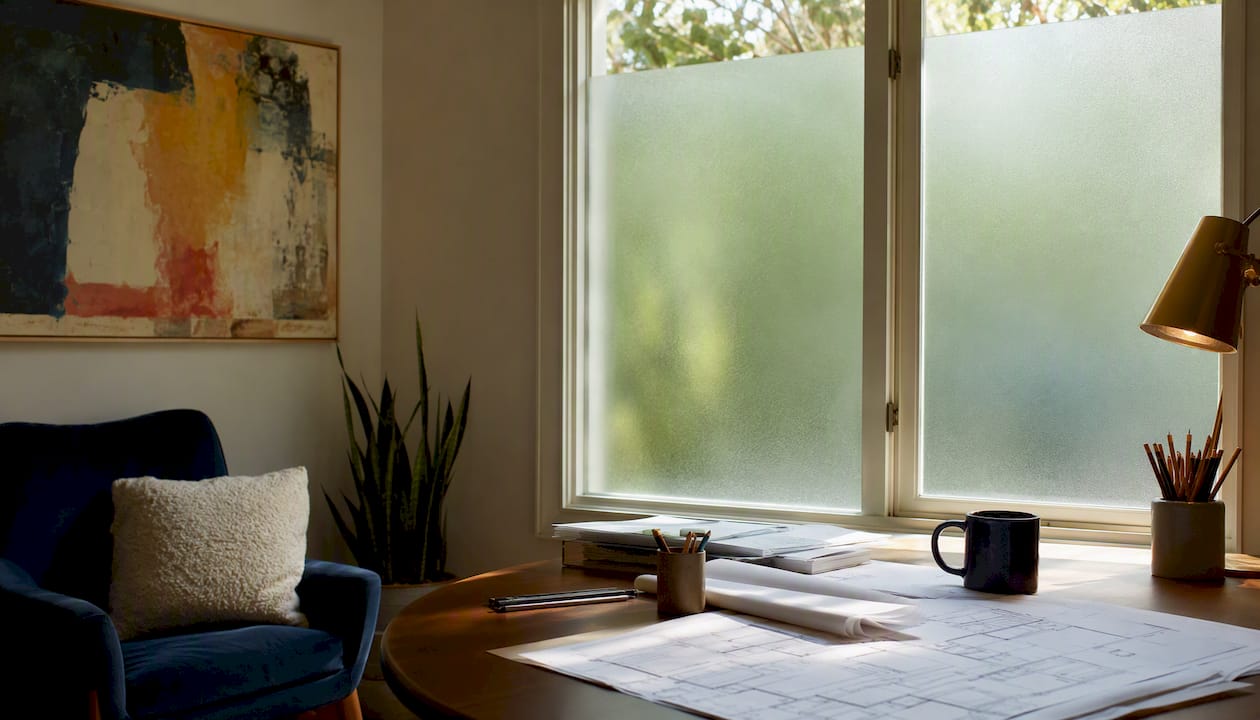
The night-visibility problem is the one limitation that catches buyers off guard. One-way reflective films rely on the exterior being brighter than the interior. Once the sun goes down and interior lights are on, the reflective effect reverses: people outside can see in. Frosted films do not have this problem — they scatter light in both directions — but they also eliminate the outward view entirely. If your team needs to see out, frosted is not the right choice for every pane.
Durability varies by adhesive type. Pressure-sensitive adhesive films bond permanently and last 10–15 years with proper installation. Static-cling films are repositionable but more prone to peeling at edges in high-traffic areas. Scratch resistance matters on interior glass that gets touched frequently; look for a hard-coat surface layer in the product specs.
DIY peel-and-stick film or professional installation — which one is right for you?
For a single interior window in a low-traffic area, a peel-and-stick frosted film is a reasonable option. For anything else in a commercial setting, hire a professional.
Here is why that line exists where it does.
DIY film: when it works
- Small, flat interior panes with no complex cuts or curves
- Temporary applications where repositionability matters
- Budget-constrained projects where longevity is not a priority
- Standard annealed glass with no special coatings
DIY film: the real risks
- Tempered glass and insulated glass units have thermal stress limits. The wrong film on the wrong glass can cause thermal breakage, a risk most DIY product labels do not explain clearly.
- Bubbles, misaligned seams, and edge lifting are common without professional tools and technique.
- No warranty coverage. Most manufacturers tie their product warranty to certified installer application.
- Custom cuts for branding or die-cut logos are not achievable with consumer-grade tools.
Professional installation: what you actually get
- An on-site glass compatibility check before any film is ordered
- Precise die-cut patterns and branded graphics
- Manufacturer-backed warranty tied to certified installation
- Films that are not available through retail channels, including ceramic window film grades with higher heat rejection
Pro Tip: If your office has tempered glass, insulated double-pane units, or any glass with a factory low-E coating, do not attempt DIY film. The thermal stress risk is real, and a cracked pane costs far more than a professional install. A certified installer will assess glass compatibility before recommending any product.
How do you choose the right privacy film for your office?
Start with these six questions before you request a single quote.
- What is the privacy goal? Full visual block, partial obscuring, or daytime-only privacy?
- What VLT range do you need? Most offices work well with 40–60% VLT to keep spaces bright.
- Do you need custom branding? Logos, frosted graphics, and die-cut patterns require professional installation.
- What is the expected lifespan? Permanent adhesive films last longer; static-cling films trade longevity for flexibility.
- Is the glass tempered, insulated, or coated? This determines which films are safe to apply.
- What are the building code requirements? Some commercial leases and local codes restrict exterior-facing reflective films.
Film type comparison
| Film type | Privacy level | VLT retained | Adhesive type | UV/heat reduction | Durability/warranty | Customization | Install complexity |
|---|---|---|---|---|---|---|---|
| Frosted/etched | Medium–high | 40–60% | Pressure-sensitive or static cling | Moderate UV block | 5–15 years; warranty with pro install | High (die-cut, logos) | Low–medium |
| Gradient | Medium | 40–60% | Pressure-sensitive | Moderate | 10–15 years with pro install | Medium | Medium |
| One-way reflective | High (daytime) | 20–50% | Pressure-sensitive | High heat rejection | 10–15 years | Low | Medium–high |
| Blackout | Total | — | Pressure-sensitive | High | 10–15 years | Low | Medium |
| Switchable (smart) | Adjustable | Variable | Adhesive-mounted panel | Low–moderate | 5–10 years | Low | High |
| Ceramic/solar tint | Medium | 40–60% | Pressure-sensitive | Very high | 10–15 years; warranty with pro install | Medium | High |
Pricing and timeline: Commercial window film installations vary by square footage, film type, and building access. For a realistic cost range and what affects the final number, the commercial window tint cost breakdown covers the key variables. Most commercial projects complete in one to three days once film is ordered.
Questions to ask every vendor before signing:
- Do you conduct an on-site glass compatibility check before recommending a film?
- What warranty do you offer, and is it tied to manufacturer certification?
- Can I see free samples applied to my actual glass before committing?
- What is your process for custom cuts or branded graphics?
- How do you handle thermal stress risk on tempered or insulated units?
Red flags to walk away from:
- No site survey offered before quoting
- Vague or verbal-only warranty with no written documentation
- No free samples available
- Pressure to decide same-day without seeing the film on your glass
- No mention of glass type compatibility during the sales conversation
Why professional installation delivers better results
Professional installation is not just about convenience. It is the difference between a film that performs as specified and one that fails within two years.
Certified installers access commercial-grade films with scratch-resistant coatings and precise die-cut branding that retail products do not offer. More importantly, they match the film to the glass type on-site, which is the step that prevents thermal breakage and preserves any manufacturer warranty. Manufacturer-certified installation is the condition under which both product and labor warranties transfer to the building owner.
The energy performance numbers are real. Tintadvantage clients have reported cooling cost reductions of 10–20% after commercial film installation, and the company’s high-performance films are rated to reduce heat gain by up to 80%. That is not a marginal improvement on a south-facing glass wall in July.
Professional window film installation is the only path to warranty-backed performance. A certified installer checks glass compatibility, selects the right product, and applies it with tools and technique that consumer kits cannot replicate. The result is a film that lasts, performs to spec, and keeps your warranty intact.
For office window tinting projects specifically, a site survey is the right starting point. It confirms which films are safe for your glass, shows you samples in your actual light conditions, and produces a scoped quote with no guesswork.
Key Takeaways
Professionally installed frosted or ceramic privacy film is the most reliable office privacy solution, balancing confidentiality, natural light, and long-term durability with warranty-backed performance.
| Point | Details |
|---|---|
| Choose film by room function | Frosted for conference rooms, one-way reflective for exterior glass, switchable for boardrooms. |
| Verify VLT before ordering | Most offices need 40–60% VLT to stay bright while blocking sightlines. |
| Night visibility is a real limit | One-way reflective films reverse at night; frosted films maintain privacy around the clock. |
| Pro install protects your investment | Certified installation is required for manufacturer warranty coverage and safe application on tempered or insulated glass. |
| Tintadvantage next step | Schedule a free site survey with Tintadvantage to confirm glass compatibility and see samples before committing. |
The case for getting a site survey before you buy anything
Most office managers I talk to have already picked a film type by the time they call. That is fine, but the site survey almost always changes something: the glass turns out to be tempered, the VLT they wanted cuts too much light in the north-facing rooms, or the branding idea they had in mind needs a die-cut that requires a different adhesive. Getting that information before ordering saves real money and prevents the frustration of a film that looks wrong or fails early.
The warranty question is the one I would push hardest on. A film without certified installation behind it is an uninsured asset. When a client asks me whether to save money with a DIY kit on their conference room glass, my answer is always the same: the kit costs less today and more later. A professional install, done right, should last 10–15 years with no maintenance beyond cleaning.
If you are pairing new film with an interior door or partition upgrade, coordinate the two projects before either one starts. Film applied to glass adjacent to a new door frame is much cleaner when both trades work from the same plan.
Tintadvantage installs privacy film that actually lasts
Tintadvantage installs high-performance privacy films for commercial properties, with every project starting from a free on-site survey that confirms glass compatibility, applies real samples in your space, and produces a scoped quote with a written warranty.
Here is what to expect on a Tintadvantage site survey:
- Measurements of every pane and assessment of glass type (tempered, insulated, coated)
- Sample application so you see the actual film in your light conditions before committing
- Product recommendation matched to your privacy goals and VLT requirements
- Timeline and pricing scoped to your project, not a generic estimate
- Written warranty covering both product and labor
Free samples are available on request. Request your site survey and get a written quote from Tintadvantage before you order anything.
Useful sources and further reading
These resources support product specification, design decisions, and installer selection for commercial window film projects.
- Decorative Films — One-Way Visibility: Technical explanation of how one-way reflective films behave during the day versus at night, with product options.
- Decorative Films — Window Film for Offices: Office-focused product gallery covering gradient, patterned, and frosted options for conference rooms and partitions.
- Tintadvantage — Conference Room Privacy Film: Application-specific guidance and examples for conference room film selection and installation.