
One Way Window Film for Homes and Offices: Privacy + Heat Control
Dual-reflective or ceramic one way window film delivers reliable daytime privacy and measurable solar control. For lasting results, professional installation by Omaha Window Tinting is the recommended path. High-performance films can reject over 80% of solar energy and block over 99% of UV rays, and a proper thermal stress check before installation protects your glass from damage. Schedule a free estimate at tintadvantage.com or call to discuss your project.
Table of Contents
- How does one way window film actually work?
- What types of one way film are available?
- What are the real privacy limits of one way film?
- What other benefits do these films deliver?
- DIY vs. professional installation: which is right for you?
- How to choose the right film for your situation
- What does professional window film installation cost?
- Why professional installation delivers better results
- Key Takeaways
- Why I favor dual-reflective and ceramic films for most clients
- Tintadvantage installs the films this article recommends
- Useful sources and further reading
How does one way window film actually work?
The physics are simple: light always travels from the brighter side to the darker side. One way window film, technically called a one way mirror film or solar mirror film, exploits that principle by coating glass with a thin metallized or sputtered layer.
Here is what controls the effect:
- Visible light transmission (VLT): The percentage of visible light the film lets through. Lower VLT means a darker film and a stronger mirror effect from outside.
- Reflectivity: The metallized layer bounces light back on the bright side, creating the mirror appearance. The darker interior stays transmissive.
- Interior vs. exterior illumination: When exterior light is stronger than interior light, the outside looks like a mirror and you can see out clearly. Flip that ratio and the effect reverses.
A street-facing living room at noon is a textbook case. Sunlight floods the exterior while your interior stays dim, so passersby see their own reflection. The same window at 9 PM, with your lights on and darkness outside, becomes a fishbowl. A storefront or conference room works the same way.
Pro Tip: To preserve nighttime privacy, pair your film with exterior lighting (a porch light or landscape fixture aimed at the glass) or use interior shades after dark. The goal is keeping the exterior brighter than the interior.
What types of one way film are available?
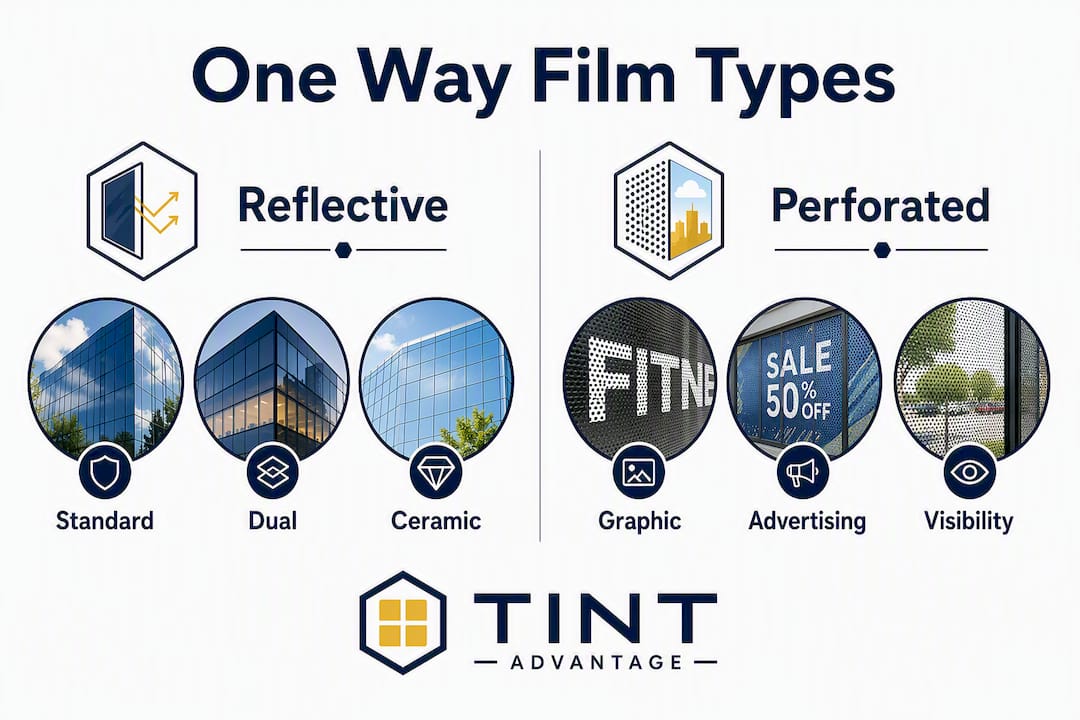
Film technology has moved well past basic silver mirror. Each category solves a different problem.
| Film Type | Typical VLT | External Reflectance | Best For |
|---|---|---|---|
| Standard reflective (silver) | 5%–20% | High | Maximum daytime privacy, heat rejection |
| Dual-reflective | 5%–15% | High exterior, low interior | Residential, offices needing nighttime outward view |
| Perforated / one-way vision | — | Low | Storefront signage, vehicle wraps |
| Ceramic / sputtered | 15%–50% | Moderate | Clarity, color neutrality, IGU compatibility |
| Exterior-applied reflective | 5%–20% | High | Buildings where interior install is impractical |
Standard reflective films create a strong mirror exterior under daylight. They are the most affordable option and work well on single-pane glass in spaces where nighttime privacy is handled by shades. The trade-off: they raise internal reflectivity at night, turning your window into a mirror from the inside.
Dual-reflective films solve that problem through layered construction. Optivision Reflective from Madico, available in 5% and 15% VLT, engineers low internal reflectivity while keeping high external reflectivity for daytime privacy. Homeowners and office managers who want to see out clearly after dark consistently prefer this category.
Perforated films are a different animal. They carry printed graphics on a micro-perforated vinyl sheet, so the image is visible from outside while occupants see through the holes from inside. These are the films you see on storefront windows and transit advertising.
Ceramic and sputtered films skip the metallic layer entirely, using nano-ceramic particles instead. The result is color-neutral, non-reflective from inside, and compatible with a broader range of glass types including many insulated glass units (IGUs). For more on how ceramic films perform, see ceramic window film.
For homeowners, dual-reflective or ceramic is almost always the right call. For storefronts needing advertising, perforated vision film handles both jobs at once.
What are the real privacy limits of one way film?
Daytime privacy depends entirely on the exterior being brighter than the interior. That condition holds reliably from mid-morning through late afternoon on sun-exposed glass. It fails the moment you flip on interior lights after dark.
Common failure modes worth knowing before you buy:
- Interior backlighting: Overhead lights, lamps, or screens behind the glass overpower the exterior at night and eliminate the mirror effect.
- Low-E glass coatings: Some Low-E glass already carries a reflective coating that can interfere with film adhesion or change the optical result. An on-site assessment is required before installing on Low-E glass.
- Wrong film selection: A film with too-high VLT (say, 35%–50%) provides weak daytime privacy on north-facing or shaded glass where exterior light is already limited.
- Reflective interior surfaces: Light-colored walls, polished floors, or mirrors near the window can bounce interior light back toward the glass and reduce the contrast ratio.
One way mirror film is not a substitute for a shade or blind after dark. It is a daytime privacy tool that also controls heat and glare. Treat nighttime privacy as a separate problem and solve it with window coverings or exterior lighting.
On the legal side: most residential and commercial window film installations in the United States do not require a permit, but some municipalities and HOAs restrict exterior reflectivity levels. Check with your local building department or HOA before specifying a high-reflectance film.
What other benefits do these films deliver?
Privacy is the headline, but the energy and comfort numbers are often what close the decision for homeowners and facility managers.
Professional-grade reflective and ceramic films can reduce solar energy absorption by over 80%, cut glare by up to 91%, and block over 99% of UV rays. As a concrete product-level example, one high-reflective film carries a solar energy transmittance of 7.9%, IR rejection of 92.6%, and UV rejection of 99%.
| Performance Metric | Typical Range (Professional Films) |
|---|---|
| Total Solar Energy Rejection (TSER) | Over 80% |
| Glare reduction | Up to 91% |
| UV rejection | Over 99% |
| VLT (visible light through) | 5%–50% depending on film |
Key figure: Over 99% UV rejection is achievable with high-performance reflective films, which directly reduces fading on furniture, flooring, and artwork.
The practical implication for buyers: less solar heat entering the building means your air conditioner runs less. Industry case reports document multi-year ROI driven by reduced HVAC load after film installation. For homes and offices with large south- or west-facing glass, the energy savings from UV protection window film alone can offset installation costs over time. Window film also helps reduce air conditioning load, which is a consistent finding across residential applications.
DIY vs. professional installation: which is right for you?
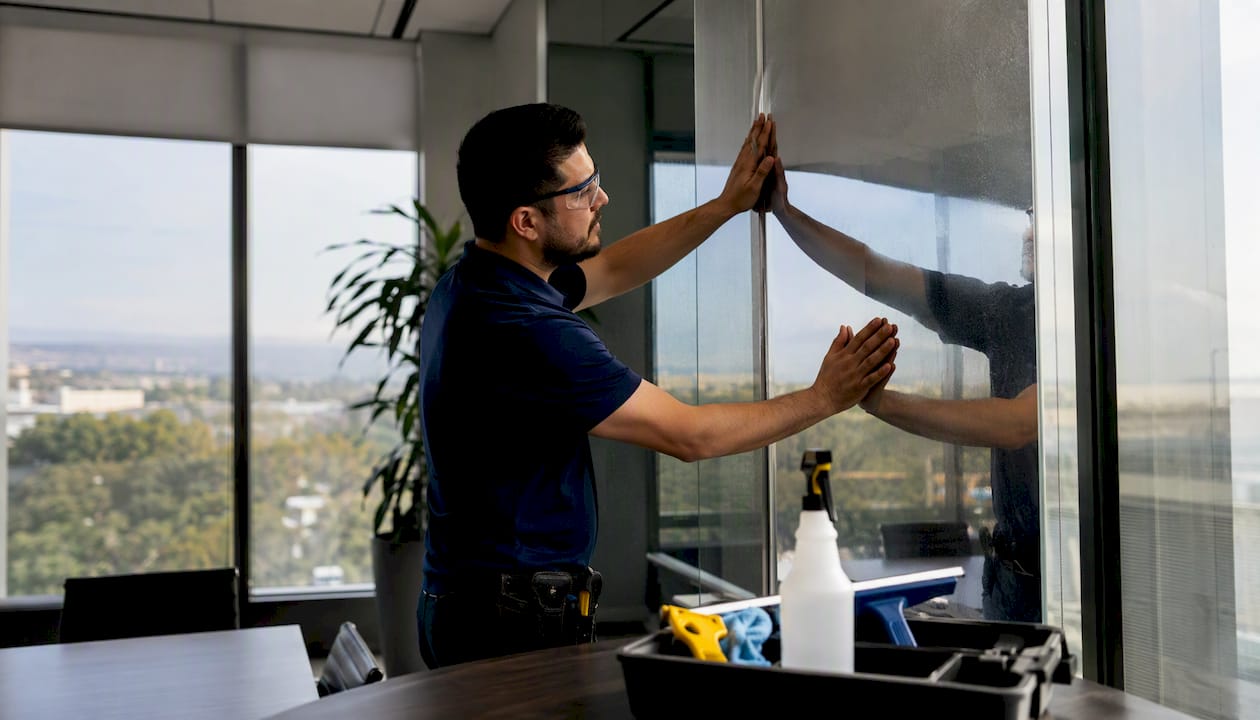
Small static-cling films on a bathroom window? DIY is fine. High-performance dual-reflective or ceramic film on a commercial facade or dual-pane IGU? Hire a professional.
The gap between those two scenarios is wider than most buyers expect.
When DIY works: Low-cost static-cling or self adhesive window film on single-pane glass in a low-stakes location. You are experimenting with the look, the cost is low, and you accept that the result may show bubbles, uneven edges, or lifting within a year or two.
When professional installation is strongly recommended:
- Dual-pane insulated glass units (IGUs): film changes how the interior pane absorbs heat, which can cause thermal stress fractures if the wrong film is applied without a compatibility check.
- Commercial facades with large glass panels where optical uniformity matters.
- Any high-performance film where the manufacturer warranty requires certified installation.
- Glass with existing coatings (Low-E, tinted, tempered) that need compatibility verification.
Applying a dark or highly reflective film to an IGU without a thermal stress assessment is one of the most common causes of glass cracking after DIY installation. The interior pane heats unevenly, and the seal fails or the glass fractures.
Professional installers perform edge sealing, use commercial-grade slip solutions for bubble-free adhesion, and cut film precisely to the sight line rather than the frame edge. The optical result is noticeably cleaner. More practically, manufacturer warranties on films like Madico’s product lines are typically void without certified installation.
Pro Tip: When vetting an installer, ask specifically: “Do you perform a thermal stress assessment for insulated glass?” and “Does the manufacturer warranty require your certification?” If they cannot answer both clearly, keep looking.
How to choose the right film for your situation
Start with the outcome you care about most. If daytime privacy plus a clear nighttime outward view matters, dual-reflective or low-internal-reflectivity ceramic film is the right family. If maximum heat rejection on a budget is the priority and you have single-pane glass, standard reflective film gets the job done.
Buyer checklist for vendor calls:
- What VLT do I need? (Lower = stronger privacy and more heat rejection, but darker interior)
- What is the film’s TSER and IR rejection rating?
- Is this film rated for my glass type (single-pane, IGU, Low-E, tempered)?
- What is the warranty length and does it require certified installation?
- What is the expected lifespan under normal conditions?
- What cleaning products are safe after the film cures?
- What does installation prep involve (furniture moving, window cleaning)?
Questions to ask the installer directly:
- How many IGU installations have you completed, and do you run thermal stress checks?
- Can you provide a sample spec sheet for the film you are recommending?
- What does your warranty cover and who backs it: you or the manufacturer?
- Do you handle cleanup and a post-installation inspection?
One note on glass compatibility: if your windows are Low-E or already tinted, an on-site assessment is not optional. The combination of coatings can affect both adhesion and thermal performance in ways that a phone quote cannot catch.
What does professional window film installation cost?
Price ranges vary by film type, glass area, and complexity. Here is a realistic picture:
- DIY rolls: Self adhesive window film in standard reflective runs roughly $1–$3 per square foot for the material alone, not counting tools or the time to redo mistakes.
- Professional installation, standard reflective film: Typically $5–$12 per square foot installed, depending on glass area and access.
- Professional installation, dual-reflective or ceramic film: Generally $10–$20+ per square foot installed, reflecting higher material cost and more precise installation requirements.
Factors that move the price:
- Film type and brand tier
- Total glass area (larger jobs often carry lower per-square-foot rates)
- Single-pane vs. insulated glass (IGU work takes longer and carries more liability)
- Access complexity (high windows, curved glass, scaffolding requirements)
- Geographic market and local labor rates
For a detailed breakdown of what drives commercial window tint cost, the variables are similar but scale up with facade size.
Typical installation timeline:
- Site assessment and glass-type verification: 30–60 minutes
- Measuring and templating: included in assessment or a separate visit
- Scheduling: 1–2 weeks out for most residential jobs; commercial projects may require longer lead time
- Installation day: a standard home (4–8 windows) typically takes 2–4 hours
- Curing period: most films reach full adhesion in 3–7 days; avoid cleaning during this window
ROI on energy savings varies by climate and glass area, but industry case reports consistently show that high-TSER films on sun-exposed glass can pay back installation costs within a few years through reduced cooling loads.
Why professional installation delivers better results
Professional installation produces more reliable privacy, better optical clarity, and lower risk of glass damage or warranty loss than DIY application on any film above the entry-level tier.
Omaha Window Tinting’s process at every job:
- Onsite assessment of glass type, orientation, and existing coatings
- Thermal stress analysis for insulated glass units
- Film selection matched to glass compatibility and client performance goals
- Surface preparation and professional-grade installation with edge sealing
- Final inspection for optical uniformity and adhesion quality
The performance claims are grounded in the film lines Tintadvantage installs: reject over 80% of solar energy and client-reported cooling cost savings. Clients consistently note immediate comfort improvements, particularly in west-facing rooms that were previously unusable in the afternoon.
Professional installation is not just about a cleaner finish. It is the difference between a film that lasts 10–15 years and one that peels, bubbles, or cracks your glass within 18 months.
Office window tinting projects follow the same methodology, with additional attention to uniform appearance across large glass panels and coordination with building management.
Key Takeaways
One way window film delivers reliable daytime privacy and measurable solar control, but dual-reflective or ceramic films installed by a certified professional give the best long-term results for homes and offices.
| Point | Details |
|---|---|
| Daytime privacy has limits | The mirror effect works when exterior light exceeds interior light; it reverses at night without shades or exterior lighting. |
| Film family matters | Dual-reflective films reduce internal reflectivity for clearer nighttime views; standard silver films do not. |
| Performance is measurable | Professional-grade films can reject over 80% of solar energy and block over 99% of UV rays. |
| IGUs need a pro | Applying film to insulated glass without a thermal stress check risks glass cracking and voids manufacturer warranties. |
| Tintadvantage recommendation | Omaha Window Tinting installs dual-reflective and ceramic films with glass compatibility checks and full warranty support. |
Why I favor dual-reflective and ceramic films for most clients
The mirror film category gets oversimplified constantly. Buyers see “one way privacy” on a product listing and assume the problem is solved. What they miss is the internal reflectivity issue: a standard silver film turns your window into a mirror from the inside at night, which is disorienting in a living room and genuinely annoying in an office.
Dual-reflective films solve that without sacrificing daytime privacy. The engineering difference is real and the occupant experience is noticeably better. For most residential clients and any office with evening hours, that upgrade is worth the modest price difference.
The energy argument is often underweighted too. Clients come in focused on privacy and leave talking about how much cooler their south-facing rooms feel. Reflecting solar heat before it enters the glass is immediate and physical. You feel it the first afternoon. The AC savings accumulate over years, but the comfort improvement is day one.
My honest recommendation: if you are installing on IGUs or any glass with an existing coating, do not attempt it yourself. The thermal stress risk is real and the cost of replacing a cracked pane far exceeds the installation fee you were trying to avoid.
Tintadvantage installs the films this article recommends
Tintadvantage (Omaha Window Tinting) installs dual-reflective and ceramic window films for residential and commercial properties, with glass compatibility checks built into every project.

Every standard installation includes:
- Onsite assessment and glass-type verification
- Thermal stress compatibility check for insulated glass
- Professional installation with edge sealing
- Manufacturer warranty registration
Tintadvantage serves the 21162 and 21145 zip code areas and surrounding communities. Most residential projects are scheduled within one to two weeks, with installation completed in a single visit. To get a quote or book your assessment, visit tintadvantage.com and request a free estimate.
Useful sources and further reading
Manufacturer spec sheets and industry supplier pages are the most reliable place to verify film performance data and warranty terms before you commit to a product.
- Madico Reflective Silver: Detailed performance specs including TSER, glare reduction, and UV rejection for a professional-grade reflective film line.
- Madico Optivision Reflective: Spec data and engineering notes for dual-reflective film in 5% and 15% VLT, including internal reflectivity comparisons.
- Energy Products Distribution: One-Way Mirror Window Film: Explains the light-differential mechanism and construction of mirror films.
- Gordon Glass: One Way Mirror Window Film: Product-level spec example with solar transmittance, IR rejection, and UV figures for a high-reflective roll.
- Windowtint.com: Premium Dual Reflective 15% VLT: Supplier page with performance claims and application guidance for dual-reflective film.
- Window treatments: privacy, light control, style: Supplemental perspective on how window film fits into a broader privacy and energy-control strategy for homes.