Tenant Privacy Window Film: A Property Owner's Guide
Yes, professional tenant privacy window film is worth the investment for most properties dealing with glare, heat, or tenants who feel like they’re on display. Tintadvantage installs 3M architectural films that cut heat gain by up to 80% while keeping rooms bright, not cave-dark. Before you sign anything, weigh these three factors:
- Privacy level needed (full block versus soft diffusion)
- Visible light transmission (how much daylight survives)
- Installer warranty (manufacturer-backed beats a handshake deal)
Ready to see what your glass actually needs? A site survey answers that in about 20 minutes.
Key Takeaways
Professionally installed privacy film solves tenant privacy, glare, and heat problems at a lower cost and faster timeline than full glazing replacement.
| Point | Details |
|---|---|
| Privacy without losing light | Frosted and ceramic films block sightlines while letting daylight through, unlike blinds. |
| Heat and UV performance | Quality architectural film can reject up to 80% of heat gain and block nearly all UV rays. |
| Installation is fast | Most residential jobs finish in an afternoon; commercial projects phase across days. |
| Warranty coverage matters most | Confirm both manufacturer product warranty and installer workmanship warranty before signing. |
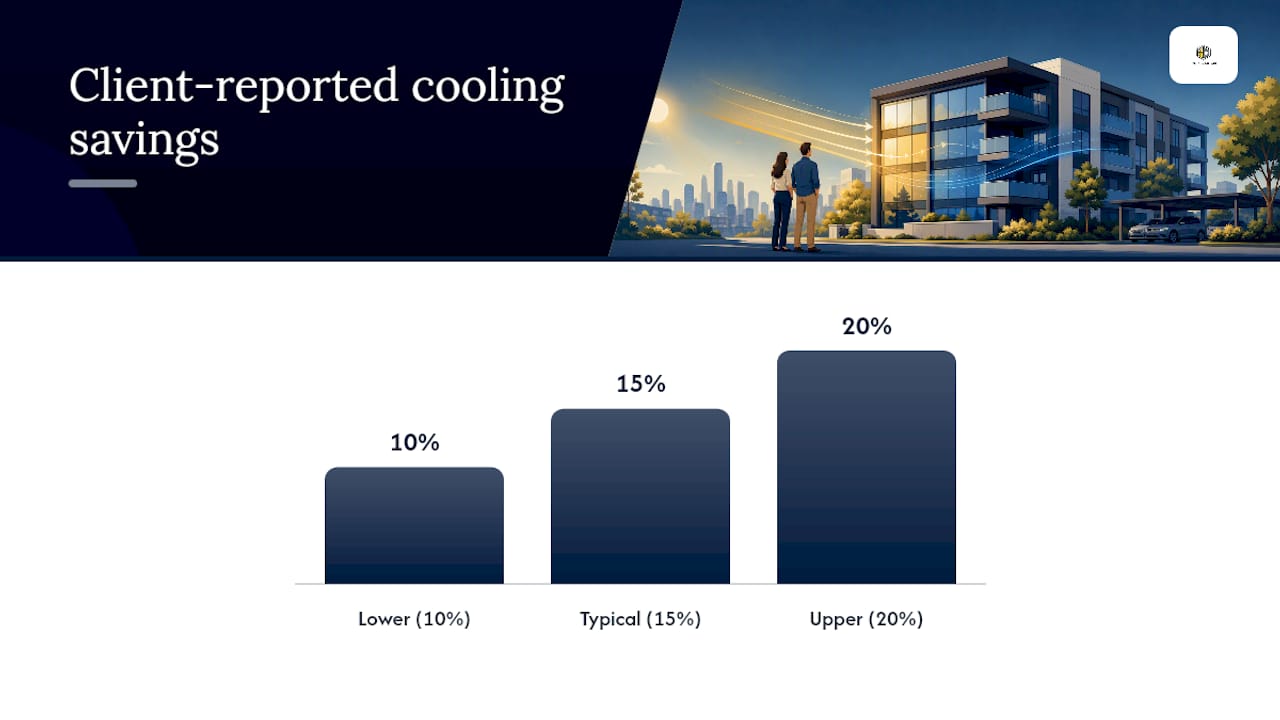
| Tintadvantage delivers documented results | Tintadvantage installs manufacturer-authorized film with client-reported cooling savings of 10 to 20%. |
Table of Contents
- Why Property Owners And Managers Invest In Professional Privacy Film
- Which Privacy Film Type Fits Your Property?
- What Happens During A Professional Installation?
- What Does Professional Film Installation Cost, And Is It Worth It?
- How Do You Choose A Qualified Privacy-Film Installer?
- How Long Does Privacy Film Last, And What Maintenance Does It Need?
- What Results Do Property Owners Actually See?
- Should You Hire A Professional Or Handle It Yourself?
- Which Film Material Actually Holds Up Best Over Time?
- When Should You Actually Call A Pro?
- How Tintadvantage Makes Professional Film Installation Simple
- Frequently Asked Questions
- Sources
Why Property Owners And Managers Invest In Professional Privacy Film
Tenants who feel like they’re living in a fishbowl don’t renew leases. That’s the blunt version, but it’s true, and it’s why smart owners treat privacy film as a retention tool, not a cosmetic upgrade. The right film solves glare on monitors, blocks UV that fades furniture and flooring, and takes the edge off a west-facing unit during a humid, 95-degree scorcher.
Here’s what professional installation actually delivers:
- Tenant comfort — reduced glare and heat means fewer complaints and fewer maintenance calls.
- Lower HVAC load — installer-reported data shows quality architectural films can reject up to 78% of solar heat, which takes real pressure off aging AC units.
- Furnishing protection — UV rejection blocks nearly all UV, which slows the fading that turns showroom-fresh interiors dingy in two summers.
- Privacy for partitioned offices — conference rooms, HR spaces, and ground-floor units all need sightline control without going full blackout.
If a unit generates repeat complaints about heat or glare, or a lease requires visual privacy for partitioned space, that’s your signal to bring in a professional rather than patch the problem with blinds.
Which Privacy Film Type Fits Your Property?
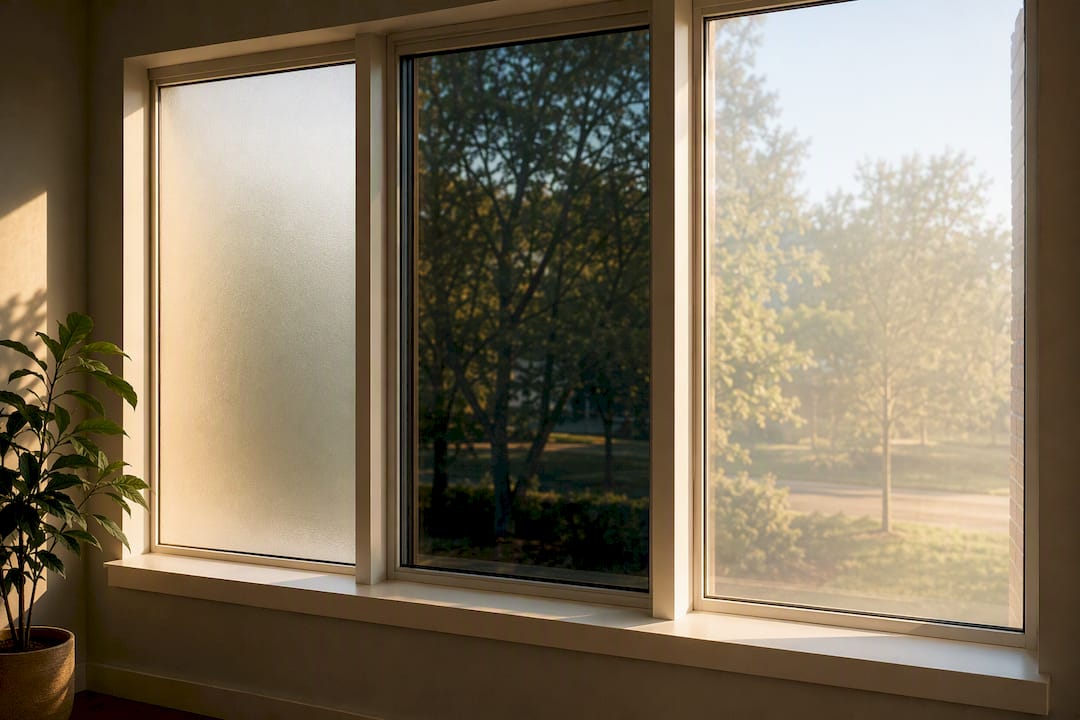
For most tenant-facing spaces, frosted or etched decorative film wins because it blocks sightlines while letting daylight pour through, so rooms stay bright instead of feeling sealed off. But it isn’t the only option worth knowing.
- Frosted/decorative film — ideal for conference rooms, exam rooms, and shared offices where you want privacy without losing light.
- Reflective/solar film — best for street-level windows needing privacy plus real solar control.
- Ceramic film — delivers high visible light transmission with strong heat rejection, a favorite for storefronts and lobbies.
- Safety/security film — adds shatter resistance in thicknesses typically measured in mil, useful for ground-floor glazing.
- Switchable (smart) film — lets tenants toggle privacy on demand, a premium option for conference rooms and executive offices.
Four numbers matter when comparing proposals: visible light transmission (VLT), the percentage of daylight passing through; heat rejection, often cited up to 78% for architectural films; UV rejection, which can approach 99% on quality product; and, for security applications, thickness in mil. Architectural privacy films specifically allow diffused daylight while blocking line-of-sight, which is exactly the tradeoff a tenant-facing space needs. Push VLT too low and you lose daylight; push it too high and privacy suffers. A good ceramic window film split the difference well for street-facing retail glass.
What Happens During A Professional Installation?
Most residential jobs wrap in an afternoon. Larger commercial floors get phased across a few days so the building stays operational. Here’s the typical sequence:
- Site survey and measurement — the installer checks glass type, orientation, and existing film.
- Product selection and sample demo — you see and feel the film on your own glass before committing.
- Prep and protection — furniture moved, floors covered, workspace sectioned off.
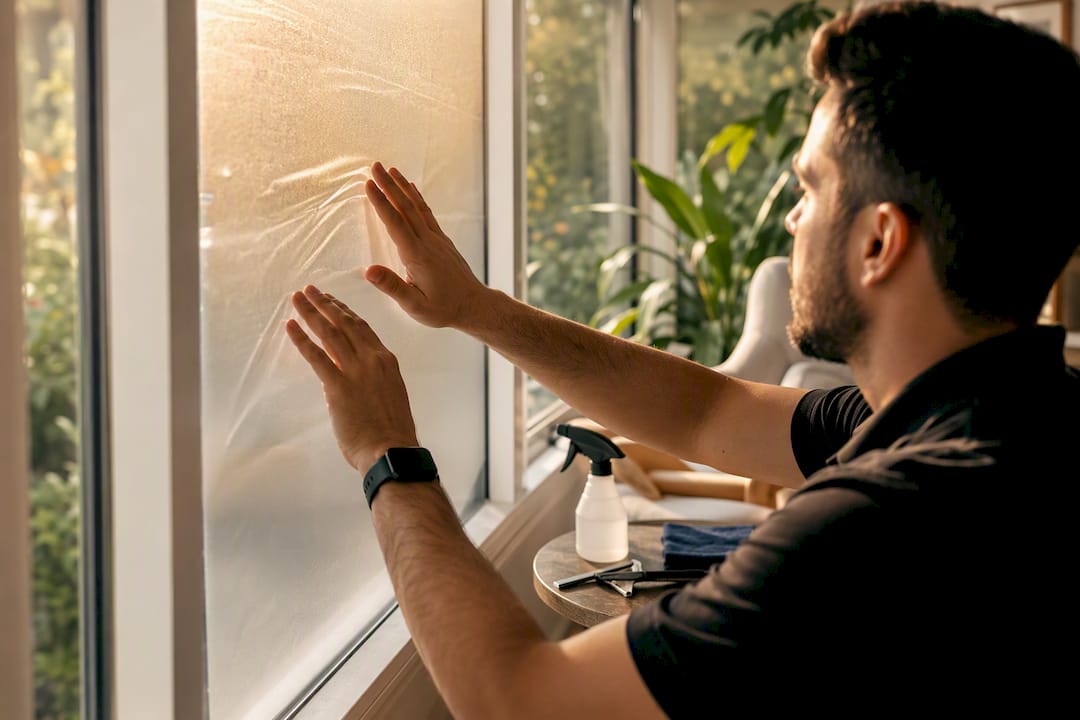
- Glass cleaning and application — wet-mount placement with squeegee work from center out, followed by edge finishing and notched corners to prevent lifting.
- Curing and final inspection — small bubbles are normal and dissipate within a day or two.
Before the crew arrives, clear furniture from window paths, secure pets, and reserve elevators if it’s a multi-floor commercial job. Low-e, tempered, or dual-pane glass sometimes needs extra checks, since certain films interact differently with those coatings.
Pro Tip: Ask your installer to phase a commercial project by floor or wing so the rest of the building keeps functioning while one section cures.
What Does Professional Film Installation Cost, And Is It Worth It?
Professional film almost always costs less upfront than full glazing replacement, and it can deliver measurable cooling savings fast. Several factors move the price:
- Film type and thickness (ceramic and security films cost more than basic solar films)
- Number and size of glass panels
- Access complexity (upper floors, tight commercial spaces)
- Travel and equipment needs
- Warranty length and coverage
Treat any per-square-foot number as a starting cue, not a firm quote, until an installer sees your glass. Client-reported results from Tintadvantage installations show cooling expenses dropping roughly 10 to 20% after professional installation, though payback depends on your local energy rates, window orientation, and how the space is used day to day.
Pro Tip: Ask installers if they can share modeled energy-savings figures or reference NFRC performance data for the exact film they’re proposing.
How Do You Choose A Qualified Privacy-Film Installer?
Hire an authorized dealer, not just a low bidder, and insist on both a manufacturer product warranty and a separate workmanship warranty. Those two protections cover different failure points, and skipping either one leaves you exposed.
Ask every estimator these questions:
- What’s the exact film spec (VLT, heat rejection percentage, thickness)?
- Can you show NFRC or manufacturer performance data for this product?
- Are you an authorized dealer, and can you prove it?
- What’s the detailed scope and total square footage?
- What does the warranty cover, and for how long?
- Can I see a sample on my own glass before committing?
Watch for red flags: evasive answers about the actual film spec, no written warranty, suspiciously low per-square-foot pricing with no defined scope, or an inability to name similar completed projects. Estimators worth trusting focus on glass compatibility and real performance metrics instead of leading with a headline price.
Pro Tip: Verify authorized-dealer status directly on the manufacturer’s website, and ask upfront whether warranty claims route through the manufacturer or the installer.
How Long Does Privacy Film Last, And What Maintenance Does It Need?
Properly installed privacy film typically lasts 10 to 15 years or more. Maintenance is minimal, but a few habits extend that lifespan:
- Clean with non-ammonia glass cleaners only; ammonia degrades the adhesive over time.
- Expect a normal cure period, often 24 to 48 hours depending on climate, where small bubbles settle out on their own.
- Watch for lifting edges or persistent hazing; both are signs it’s time to call your installer.
- Avoid abrasive scrubbers or razor blades near film edges.
Manufacturer warranties cover the product itself; installer workmanship warranties cover the application. Ask which party handles claims before you sign, and document that answer in writing. When film does reach end of life, plan removal and replacement into your capital budget rather than reacting to a tenant complaint.
What Results Do Property Owners Actually See?
A multi-unit office client came to Tintadvantage with a west-facing floor that ran hot every afternoon and tenants who’d started closing blinds permanently, killing the natural light they’d leased the space for.
- Heat gain fell dramatically, consistent with the up to 80% reduction Tintadvantage reports on similar jobs.
- The install ran during business hours with minimal disruption, and tenant complaints about glare stopped almost immediately.
The blinds came back up. That’s the real measure of success on a job like this.
Should You Hire A Professional Or Handle It Yourself?
DIY film has its place, mostly for a single small window in a low-stakes room where a slightly crooked seam won’t bother anyone. Professional privacy film is a different category entirely, and the decision comes down to a few practical checkpoints.
Choose professional installation when:
- The glass is large, oddly shaped, or on an upper floor where access is tricky.
- You need documented warranty coverage for a rental or commercial property.
- The film needs to meet a lease requirement for visual privacy in partitioned space.
- You’re covering multiple units or floors and consistency matters.
- The glass is tempered, low-e, or dual-pane, where film compatibility needs a trained eye.
DIY might work when:
- It’s a single, small, easily accessible window.
- You’re not concerned about a warranty or long-term durability.
- The stakes of a bubble or a crooked cut are cosmetic, not contractual.
For any property with tenants, a lease, or an insurance policy attached, professional installation is the safer call. A reversible, pressure-sensitive adhesive film still needs precise cutting and clean application to perform as advertised, and that precision is exactly what separates a five-year film from a fifteen-year one. Property managers increasingly treat film as a retention lever because it solves hot spots and glare fast, without the weeks of disruption a full glazing replacement demands.
Which Film Material Actually Holds Up Best Over Time?
Frosted and etched decorative films offer the strongest privacy-to-daylight ratio, but they’re not built for heavy solar exposure the way ceramic film is. Reflective solar films handle heat well and add privacy, though their mirrored look isn’t right for every storefront or facade. Ceramic film splits the difference: it holds high visible light transmission while rejecting substantial heat, and it resists fading better than dyed film over a decade of sun exposure.
Safety and security films trade some optical clarity for shatter resistance, measured in mil thickness, and they’re worth layering with security screens on ground-floor units where physical intrusion is a real concern. Switchable film is the newest category, offering on-demand privacy at a premium price point, and durability data on it is still catching up to the more established films.
For interior partitions, frosted film paired with glass interior doors creates a cohesive look between window and door treatments, which matters more than owners expect when tenants are touring a space. On raw durability, ceramic film tends to outlast dyed and even standard reflective films, particularly on south and west-facing exposures where UV load is highest. The right choice depends less on which film is “best” and more on which exposure, use case, and budget you’re solving for.
When Should You Actually Call A Pro?
Owners wait too long on this, usually until a tenant complains twice or the fading on a lobby couch becomes obvious. My advice: if you’re fielding repeat heat or glare complaints, seeing visible fade damage, or watching energy bills climb every summer, schedule a site survey now rather than next quarter. Tintadvantage’s installation data consistently shows the biggest wins come from acting before the problem compounds across multiple units.
How Tintadvantage Makes Professional Film Installation Simple
Tintadvantage handles the entire process, from the first measurement to the final squeegee pass, using manufacturer-authorized products backed by real warranty coverage instead of a vague promise. That’s the practical difference between hiring us and going the DIY-adjacent route: you get a documented, warranty-backed install instead of guesswork on your own ladder.
Here’s what a project with Tintadvantage includes:
- A site survey to measure glass and assess your specific privacy and heat needs
- Sample demos on your own glass before you commit to a film
- Manufacturer-authorized products with documented product and workmanship warranties
- Phased scheduling on larger commercial jobs to keep your building operational
If tenant complaints, fading furniture, or rising cooling costs are on your radar, request a site survey with Tintadvantage and get a real answer on what your glass needs, not a generic quote.
Frequently Asked Questions
Is professional privacy window film better than blinds for tenant spaces? Yes, for most tenant-facing offices and conference rooms. Film maintains daylight and views while blinds block both, and film requires no ongoing operation from tenants.
How long does professional installation take for a commercial building? Most jobs are phased by floor or wing, so a building stays operational throughout. Individual rooms typically finish within a day.
Does privacy film reduce cooling costs? Client-reported data from Tintadvantage shows cooling expense reductions of roughly 10 to 20% after professional installation, though results vary by orientation and local energy rates.
What’s the difference between a manufacturer warranty and a workmanship warranty? The manufacturer warranty covers the film itself against defects; the workmanship warranty covers the installer’s application. Ask which party handles claims before signing any contract.
Can privacy film work on low-e or tempered glass? Yes, but it requires an installer familiar with those glazing types, since certain films interact differently with existing coatings and may need additional checks before installation.
Sources
- What can 3M™ Window Films do for your building? — 3M Building Window Solutions
- Architectural Window Film: A complete guide for building owners — KSB Window Film